 AUG (Authorized User Group) Certified
 Nasscom Certified
 SNA Certified


A general counsel finishes the legal review in June, hands it to the operations lead, and asks how long the changes will take. The answer comes back in September: the account suspension work is a two-quarter build.
That is the shape of this deadline. The legal question was never the hard part. The hard part is that a handful of the obligations are engineering jobs wearing legal clothing, and they were quietly sitting in someone else's backlog while the legal team read the Directive. Ninety-eight days is fourteen weeks. It is enough for most of what the Platform Work Directive asks. It is not enough for two things, and those two are the ones that touch your product.
There is a second complication, and it pushes the other way. As of 1 July, not one of the twenty-seven member states had a transposing law in force so in most markets, enforcement will not begin on 2 December at all. Two clocks, running in opposite directions. Companies reading only the first feel relaxed. Companies reading only the second panic about the wrong items. This is what ready actually looks like, sorted by how long each piece takes.
How can companies prepare for the EU Platform Work Directive 2026?
Start with lead times rather than with the law, because that is what decides whether ninety-eight days is comfortable or not.
Days to weeks. Scope documentation writing down whether you meet the digital labour platform definition, in which markets, for which populations, and why you concluded that. A system inventory listing every automated tool that allocates, prices, ranks, scores, monitors or restricts. Information notices for individuals, representatives, candidates and authorities. A designated contact person appointed and trained.
One to three months. The data protection impact assessment, which cannot be finished quickly because it requires consulting the people performing platform work and their representatives before it is final. An audit of prohibited data categories off-shift location tracking is the usual failure, and switching it off is easy while evidencing that you have is not. A contractor classification review across markets, run on the facts rather than the contracts.
A quarter or more. Putting a human decision-maker into every automated path that can restrict, suspend or cut off someone's earnings. This is not a policy update. It reaches deactivation logic, admin tooling, support workflow, reason templates and the staffing model behind them.
And the second long one: the reporting pipeline. You need to produce headcount, contractual status, general terms, average duration of activity, average weekly hours, average income for people working regularly, and the clients receiving the work kept current and provided at least every six months. Most companies can pull three of those seven from systems they already have. The other four need building.
Seven items. Two of them are already tight. That is the honest state of a ninety-eight day countdown, and it is why the number matters more than it looks.
Most companies we talk to are surprised by which item turns out to be their bottleneck.
If you're running contractors or a platform model in Europe, we'll walk your setup and tell you what's realistically closable before December. Thirty minutes, and you'll know where you stand.
What does the EU Platform Work Directive require from companies by December 2026?
Strictly, nothing and that is where most of the false comfort comes from.
A directive binds member states, not companies. What binds you is the national law implementing it. Where that law does not exist, there is no domestic mechanism to enforce the obligation against a private business.
Now look at where transposition actually stands. As of 1 July 2026, no member state had a transposing law in force. Four Italy, Spain, Belgium and Portugal already have a platform-work presumption of employment in national law, put there before the Directive existed. Five were drafting. Eighteen had not started.
Since then it has moved, unevenly. Italy has published draft legislation. Germany's Federal Ministry of Labour is drafting. Ireland has run a consultation, has no draft text, and still expects to meet the deadline. The Czech Republic has published a draft Platform Work Act with key provisions expected in force on 1 January 2027 a month after the deadline it exists to satisfy.
That last detail is the fair summary of where Europe sits. The country furthest along on paper is already scheduled to be late.
Why none of that is a reason to slow down. The Commission has signalled that infringement proceedings will follow non-transposition, so the laws are coming. When they arrive, they will arrive from governments already behind and under pressure, which historically means short commencement windows rather than generous ones. Waiting for your national text gives you weeks to do a quarter of work.
How will the EU Platform Work Directive affect worker classification and employment status?
Briefly, because we covered the mechanism in the compliance checklist piece earlier this month.
Where the facts show direction and control, the relationship is presumed to be employment, and the burden shifts to you to prove otherwise. The worker, their representatives, or a national authority can invoke it. What counts as direction and control is defined nationally, not at EU level.
Two points worth holding for a countdown piece specifically.
It does not create new misclassification law. If a relationship would fail a classification test today, it already fails. The Directive does not worsen your position. It makes the position easier for someone else to challenge and harder for you to defend.
The presumption is not retroactive. For relationships already in place on 2 December 2026, it applies from that date forward only. Which makes the next ninety-eight days the window to resolve anything you would rather not have tested and that window closes whether or not your country has legislated.
What should digital labour platforms do before the December 2026 compliance deadline?
Four things, in this order, because two of them unlock the rest.
Settle scope in writing first. Everything downstream depends on it and it takes days. The definition reaches further than ride-hailing and delivery: any commercial service provided at a distance by electronic means, where organising work is an essential component. The obligations follow the work rather than the company the Directive applies to platform work performed in the EU regardless of where the platform is established and using an intermediary does not remove you from scope.
Start the engineering work before the legal position settles. The human-in-the-loop requirement comes from the Directive rather than from national discretion, so it will not change materially between drafts. Waiting means starting the longest job last.
Run the classification review while the presumption is still prospective. Anything resolved before 2 December is resolved.
Watch the countries you actually operate in, not the average. Divergence is the real story here. Germany is signalling a narrower triggering test. Spain expects only marginal adjustment to its existing framework. Poland widened labour inspectors' powers to reclassify contracts from July 2026. The Czech draft would require platform providers to register with the state labour inspectorate regardless of where they are incorporated. Building to a European average leaves you wrong in specific places.
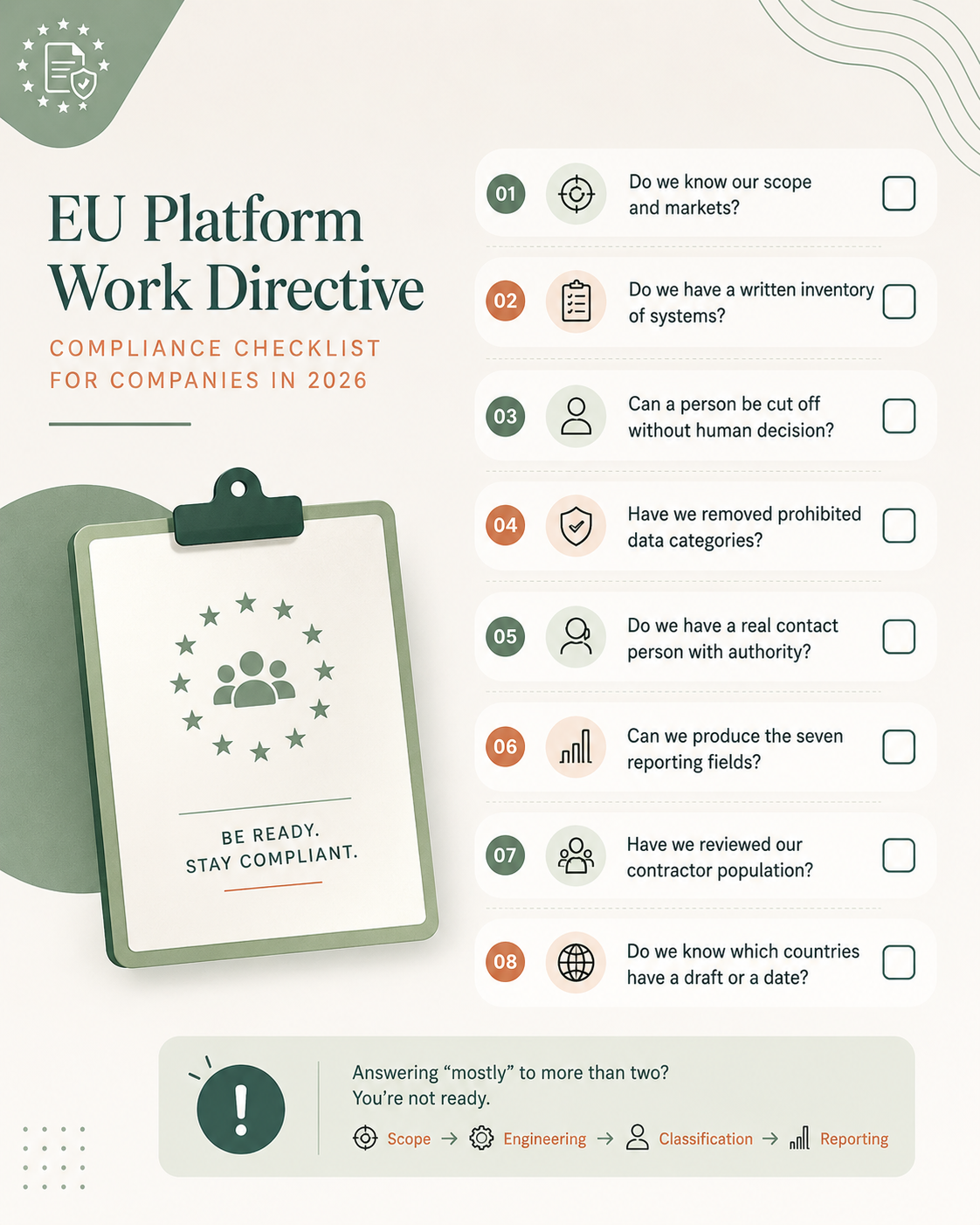
EU Platform Work Directive compliance checklist for companies in 2026
A company that is ready can answer these without going away to check.
Do we know whether we are in scope, in which markets, and can we show the reasoning?
Do we have a written inventory of every automated system affecting who gets work, what they are paid, and whether they keep their account?
Can a person be cut off from earning without a named human deciding it? If the answer is yes, that is the build ticket with the least slack left.
Have we removed the prohibited data categories, and can we evidence it rather than assert it?
Is there a real contact person named, trained, with authority rather than a support queue?
Can we produce the seven reporting fields today, or do four of them still need building?
Have we reviewed our contractor population on the facts, market by market?
Do we know which of our countries has a draft, which has a date, and which has neither?
Anyone answering "mostly" to more than two of those is not ready. The useful response to that is sequencing rather than alarm: scope, then engineering, then classification, then reporting.
 Bottom line
Ready is not a legal state. It is an operational one, which is unusual for a compliance deadline and is what makes it possible to check yourself against a list rather than an opinion.
Hold on to the two clocks. Enforcement will begin later than 2 December in most markets, because the laws are not there. The work needed to start earlier than 2 December, because parts of it take a quarter. Both things are true, and each one is misleading on its own.
Ninety-eight days covers most of this. It does not cover all of it. And the two items that need the longest runway are the two that were never really legal questions.
Get in touch with us:
Netherlands (HQ) : +31 97010207974
UK (HQ) : +44 7401131349
Belgium : +32 460254634
Follow us on:
LinkedIn : https://www.linkedin.com/company/dhi-adt/






_1790144161.jpg)







 experts@adtsolution.com


 Queens towers, Delflandlaan 1, 1062 EA Amsterdam, The Netherlands



Comments (0)
No comments yet. Be the first to comment!