 AUG (Authorized User Group) Certified
 Nasscom Certified
 SNA Certified
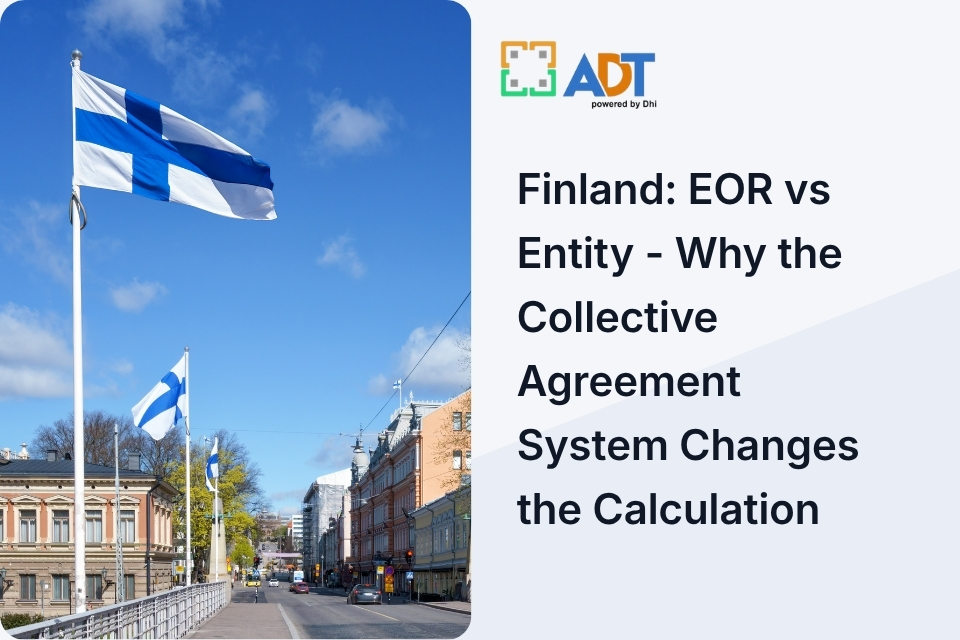
If you're looking at Finland for your next hire, the first number you will probably see is €400.
That's roughly what it can cost to set up a Finnish company.It can take one to three weeks.There is no minimum share capital.And the process is online.
So you might naturally think Why would I pay an EOR every month when I can just set up a company?
It's a fair question.
But in Finland, that question can take you in the wrong direction.The company itself is not the difficult part.The difficult part starts after you hire someone.
Finland has a strong collective agreement system. The agreement that applies to your sector can set rules for pay, overtime, holidays, sick pay and notice periods.
And in some sectors, those rules apply even if your company never joined the employers' association and never signed the agreement itself.
That's where foreign employers can get caught. You can have a perfectly valid Finnish company. You can run payroll on time. You can have good employment contracts.
And you can still be paying the wrong amount if you have not identified the right collective agreement.
So when you're comparing Finland EOR vs entity, don't start with “Which one is cheaper?”
Start with “Who is going to make sure we are getting Finnish employment rules right?”
That question will usually tell you much more about the right structure.
Finland EOR vs entity setup for hiring employees
Let's start with the part that looks easy - setting up the company.
A Finnish private limited company (Oy) can be registered for a relatively small amount.
The registration fee is €300 when using the guided online package, or €400 when filing with your own documents.
For foreign founders, the €400 route is often the practical one because the guided package requires everyone involved to have a Finnish personal identity code.
There has also been no minimum share capital since 2019.
So yes, you can get a Finnish company without putting €25,000 or €50,000 into share capital.
Registration can usually take around one to three weeks, and since January 2026, company registrations are handled online rather than through paper filing.
On paper, that sounds very attractive. And it is.
But don't confuse easy company formation with easy employment compliance.
There is also a board requirement to think about. Finnish company rules generally expect the board to have the required European Economic Area connection. If everyone on your board is based outside the EEA, you may need an exemption.
That's the kind of detail that is much easier to deal with before you file than after the registration is rejected.
Then there is the ongoing cost.
Once the company exists, you still need Finnish bookkeeping, payroll, reporting and employment administration.
You also need to report payroll information to the Finnish Incomes Register within five calendar days of each pay run.
Not once a month.Five days after each pay run.
Now compare that with an Employer of Record (EOR). The EOR becomes the legal employer in Finland.
It handles the employment contract, payroll, pension arrangements, statutory insurance, occupational healthcare and required reporting.
You still choose the employee and manage their day-to-day work. You pay an EOR fee on top of the normal employment costs.
So yes, an EOR costs more than simply paying the €400 registration fee.
But that €400 is not really the comparison.
The real comparison is:
Do you want to build the Finnish employment capability yourself, or do you want to use a provider that already has it?
How to hire employees in Finland without setting up a local entity
You don't necessarily need to set up a Finnish company just to hire someone in Finland.
There are two main routes. The first is to register as a foreign employer. A company without a Finnish establishment can employ people in Finland, but it still takes on the employer responsibilities.
You need to arrange pension insurance, including Finnish employee pension insurance (TyEL). You need statutory accident and occupational disease insurance. You need occupational healthcare. You need to handle payroll.
And you need to report to the Incomes Register within the required timeframe. Most importantly, you still need to understand which employment rules apply to your employees.
That includes the right collective agreement. The second option is an Employer of Record.
The EOR becomes the legal employer and takes responsibility for the local employment administration. You manage the employee's actual work.
This is often the easier route for a company entering Finland for the first time, especially when you only have one or a few employees and don't have Finnish employment expertise internally.
And this is where I would ask a foreign employer one simple question:
If we register as a foreign employer tomorrow, who is going to tell us which collective agreement applies to our employees?
If you already have someone who can answer that confidently, direct employment may make sense.
If nobody can answer it, you should factor that gap into the decision before choosing the entity route.
How do collective agreements affect employer costs in Finland?
This is where Finland becomes very different from what many foreign employers expect. Finland does not have a statutory national minimum wage.
So you cannot simply search for "Finland minimum wage" and use one number for your hiring budget. Instead, employment conditions are often shaped by sector-level collective agreements.
Some of these are classified as universally binding (yleissitova).
And this is the important part:
A universally binding collective agreement can apply to employers in that sector even if the employer is not a member of an employers' association and did not take part in negotiating the agreement.
So you may never have signed it.
It can still matter to you.
And these agreements can cover much more than salary.
They can set rules around:
-
Minimum pay
-
Overtime payments
-
Shift premiums
-
Holiday terms
-
Sick pay
-
Notice periods
-
Other employment benefits
Many also provide a holiday bonus in addition to normal holiday pay.
That is a real employment cost. And it is easy to miss if you're building your Finland budget from salary plus statutory contributions alone.
Here's where the risk becomes serious.
If your employment contract gives an employee less than the applicable universally binding agreement requires, the lower contractual term does not simply become valid because the employee signed it.
The applicable collective agreement can take precedence. And claims can go back several years. That means a mistake made when your first employee joined can still become a problem much later.
Imagine you enter Finland with one employee. You create a contract using your normal European template. You benchmark the salary against market data. Everything looks fine.
Then you hire four more people using the same template.
Three years later, someone asks whether the correct collective agreement was applied. Suddenly, you're not checking one employee. You're checking five. And you're not only looking at salary.
You may also need to review holiday pay, overtime, benefits and other terms. That's when a cheap entity can become a very expensive way to learn Finnish employment law.
If you're planning your first hires in Finland and nobody on your team can clearly tell you which collective agreement applies, this is exactly the point where we can help.
We'll identify the relevant agreement for your setup and review the main employment terms against it.
You'll know what applies before you make your next hire.
→ Book a 30-minute Finland Employment Compliance Review
Already have employees in Finland? Bring your current setup to the conversation. We can help you understand where the main compliance exposure may sit.
Finland collective agreement compliance for foreign employers
Once you understand the system, there are three things worth keeping in mind.
First, finding the right agreement isn't always a simple search.
You need to look at what your company actually does and match that activity against the scope of the relevant collective agreements.
For a Finnish company that has always operated locally, this may be familiar.
For a foreign company entering Finland for the first time, it can be much less obvious.
And there are around 160 universally binding agreements to consider.
Second, payroll software won't solve the problem for you.
Payroll software can calculate correctly.
But it needs to be told what rules to use.
If the wrong collective agreement is selected at the start, the system can produce perfectly accurate payslips based on the wrong rules.
That's not a payroll problem.
It's a setup problem.
Third, this isn't a one-time task.
Collective agreements can change.
Pay levels can change.
Benefits can change.
Other employment terms can change.
So even if you get the setup right today, someone needs to keep track of what changes later.
And this is true whether you have a Finnish entity or employ people through foreign employer registration.
The obligation does not disappear because the company is small.
An EOR changes the picture because the EOR becomes the legal employer and takes responsibility for these local employment obligations.
Finland EOR vs foreign employer registration: cost and compliance
Now we can make the comparison more useful.
The statutory employment costs are broadly there whichever structure you choose.
For 2026, these include employer pension insurance (TyEL), health insurance, unemployment insurance, accident insurance and group life insurance.
For a typical office employee, employer statutory costs can add roughly 20% to gross pay, depending on the employee and the exact insurance rates that apply.
Those costs don't disappear when you choose an EOR.
An EOR fee sits on top.
So if you're comparing only:
Finnish entity = €400
versus
EOR = monthly fee
the EOR will obviously look more expensive.
But that isn't the useful comparison.
The more important question is who is carrying the work and the compliance risk?
With your own Finnish entity or foreign employer registration, your team needs to handle:
-
Collective agreement identification
-
Payroll
-
Pension and insurance arrangements
-
Occupational healthcare
-
Incomes Register reporting
-
Employment documentation
-
Monitoring changes to collective agreements
-
Ongoing Finland employment compliance
With an EOR, the provider takes responsibility for the local employment relationship.
So I would not set a fixed rule like:
“At five employees, move to an entity.”
Or:
“An entity always becomes cheaper at ten employees.”
Finland doesn't work that neatly.
The better question is:
“At what point do we have enough Finnish employees—and enough local capability—to manage this properly ourselves?”
If you have two employees and a strong Finnish employment adviser already supporting you, setting up your own entity may make sense.
If you have fifteen employees but nobody internally understands Finnish collective agreement compliance, a cheap entity doesn't solve the real problem.
It can actually make it yours.
Bottom line
Finland is genuinely easy to enter from a company-formation perspective.
You can set up an entity for a few hundred euros. There is no minimum share capital.
Registration can be completed quickly. Those are real advantages.
But they're also what make Finland easy to underestimate. The difficult part isn't opening the company.
It's employing people correctly once the company is open. There is no single national minimum wage to use as your starting point.
The rules that affect your employees can sit inside a sector collective agreement. Some agreements are universally binding.
They can affect pay, overtime, holidays, sick pay, notice and other employment terms. And getting the wrong setup can create a problem long after the original contract was signed.
So before you decide between an EOR and a Finnish entity, ask yourself one question:
Who is responsible for understanding the collective agreement that applies to us?
If you have a clear answer, you can make a much more informed decision about going direct.
If you don't, that's the part you should solve first.
Because in Finland, the cheapest entity is not necessarily the cheapest way to employ someone.
Get in touch with us:
Netherlands (HQ) : +31 97010207974
UK (HQ) : +44 7401131349
Belgium : +32 460254634
Follow us on:
LinkedIn : https://www.linkedin.com/company/dhi-adt/

_1790144161.jpg)
 Blue Card, Anmeldung & Netherlands Comparison_1788936018.jpg)






 experts@adtsolution.com


 Queens towers, Delflandlaan 1, 1062 EA Amsterdam, The Netherlands



Comments (0)
No comments yet. Be the first to comment!