 AUG (Authorized User Group) Certified
 IND-recognised sponsor
 Nasscom Certified
 SNA Certified
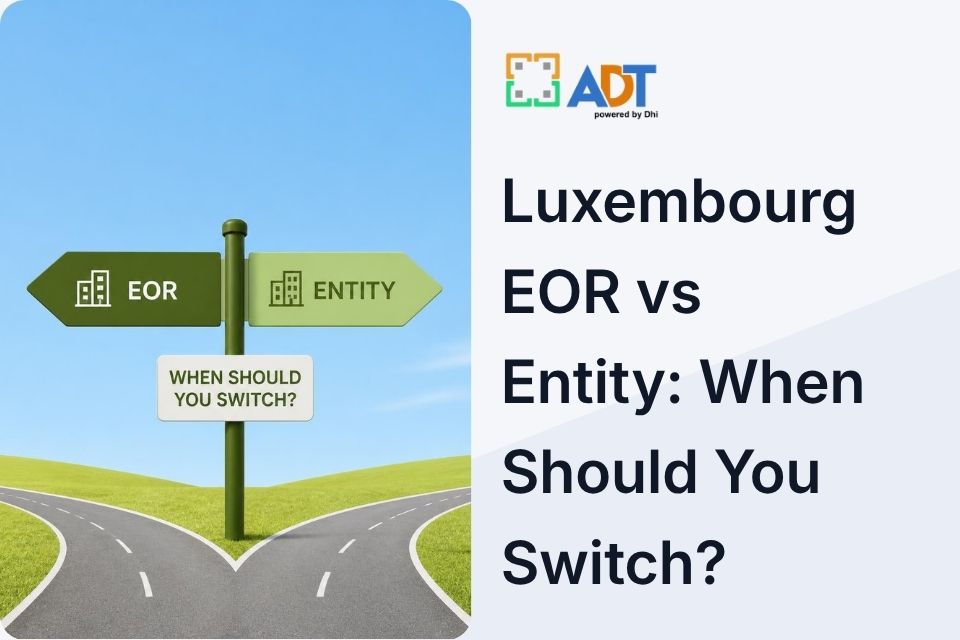

A company expanding into Luxembourg will often follow a familiar playbook.
Start with an Employer of Record. Test the market. Build the team. Think about a local entity once the headcount gets somewhere around twelve to fifteen people.
That approach makes sense in a lot of European markets. But Luxembourg can catch you out.
By the time you reach eight employees, you may find that the EOR fees have already moved past what it would cost to operate your own Luxembourg entity. And unlike Germany, where setting up can take months, Luxembourg can get you there in weeks.
So the plan you made for next year may already be late. Not because anything went wrong. Simply because the timeline you brought with you belonged to a different country.
Luxembourg changes the usual EOR-versus-entity calculation. Employer social charges are relatively low, incorporation is comparatively quick, and since June 2026, the cash payment for the required SARL capital can be deferred.
Put those together and the crossover can arrive around five to ten employees, rather than the ten-to-fifteen range companies often use elsewhere.
Is an EOR better than a legal entity in Luxembourg?
For your first few hires, usually yes. The more useful question is: How long should you stay with it?
With an EOR, you don't have to build the Luxembourg employment infrastructure yourself. The EOR becomes the legal employer, handles the Luxembourg employment contract, registers the employee with the Joint Social Security Centre, runs payroll and deals with things such as wage indexation.
Cross-border employees are another part of the picture. If someone lives in France, Belgium or Germany and works in Luxembourg, there can be tax and social security questions that are easy to underestimate.
An EOR takes much of that administration off your plate.
And you can get to the first payslip relatively quickly usually within ten to twenty working days. Setting up an entity is a different commitment.
For most companies, that means a SARL, Luxembourg's standard limited company. You'll need to deal with the notary, trade register, business permit, tax and social security registrations. Once it's in place, you're the employer and all of the responsibility that comes with that sits with you.
For one, two or three employees, the EOR is usually the easier decision.
Around five employees, the numbers deserve a proper look.
Once you move beyond ten, running your own entity will often make more sense unless there's a particular reason to keep using an EOR.
The interesting part is why the switch happens earlier in Luxembourg.
It's not because EORs suddenly become less useful. Luxembourg is simply easier and cheaper to incorporate in than many of the markets companies compare it with.
How much does entity setup cost in Luxembourg?
The cost is relatively manageable and one recent change has made the cash-flow side easier.
A Luxembourg SARL requires €12,000 in share capital, fully subscribed when the company is formed.
That requirement hasn't disappeared. What has changed is when you have to actually pay it.
Under the law of 18 May 2026, which came into force on 2 June, qualifying cash contributions covering that €12,000 can now be paid within twelve months after incorporation. That distinction matters.
You still subscribe the €12,000 when you form the company. You're simply no longer required to fund the qualifying cash contribution immediately.
And the €12,000 isn't really an operating expense. It belongs to the company and can ultimately be used for things such as salaries or rent.
But finance teams don't only look at whether something is technically a cost. They look at cash leaving the bank account today.
Removing that immediate funding pressure makes the decision easier. Then there are the actual setup costs.
Notary fees are generally around €1,800 to €3,000, depending on the shareholder structure and how complicated the setup is. You'll also have trade register filing and publication costs, plus a business permit from the Ministry of the Economy with a nominal stamp duty.
The business permit can take two to four weeks, so it shouldn't be left until the last minute.
If everything is ready and the bank account is already open, incorporation itself can take around two to three weeks.
For a foreign parent company, however, six to eight weeks door to door is a more sensible planning number. Bank onboarding is often what stretches the timeline.
That's still a very different proposition from Germany, where you're potentially looking at two to six months, or Italy, where the notarial stage alone can take four to eight weeks within a much longer overall setup process.
You may also come across the SARL-S.
It looks attractive on paper: roughly €430 to set up, €1 of capital and no notary requirement.
But there's a catch for international groups.
The SARL-S has restrictions around capital, permitted activities and shareholder structure. In particular, it only allows natural-person shareholders, which means it isn't suitable as a subsidiary owned by a company.
Cheap doesn't always mean suitable. It's worth finding that out before you build your expansion plan around it.
What makes Luxembourg's employer costs different?
This is where Luxembourg gets particularly interesting.
Employer social contributions are roughly 12.66% to 14.78% of gross salary.
Around 11.94% is fixed, covering areas such as health, pension, accident and occupational health insurance. The remaining Employers' Mutual Insurance contribution ranges from about 0.72% to 2.84%, depending on the absenteeism class assigned by the CCSS.
In other words, you're dealing with a relatively light employer statutory burden.
Compare that with France at roughly 40% to 45%, Italy at 27% to 30% plus severance accrual, Germany at 21% to 23%, and the Netherlands at around 20% to 30% plus mandatory holiday allowance.
Luxembourg is considerably lighter. And that creates an interesting EOR problem. You might assume lower employer costs mean you can comfortably stay with an EOR for longer.
Actually, the opposite can happen. Think about how the two costs behave.
An EOR fee is generally charged per employee. It doesn't suddenly become a percentage of their salary.
Statutory contributions, on the other hand, are percentage-based. In a country such as France, where statutory employer costs can be around 43%, the EOR fee is relatively small compared with the overall employment cost.
In Luxembourg, where the statutory burden is closer to 13%, that same EOR fee becomes much more noticeable. That's why the economics can turn faster.
The lower the statutory employment cost, the more visible the EOR's own fee becomes. Add relatively quick incorporation and lower setup friction, and the distance between the two models gets smaller much sooner.
There are two Luxembourg-specific points you need in your model whichever route you choose. First, wages are automatically indexed.
The index moved to 992.24 on 1 June 2026, taking the monthly unskilled minimum wage to €2,771.33 and the skilled minimum to €3,325.59.
When the relevant inflation threshold is reached, salaries increase automatically. It's not something you negotiate with employees each time.
Second, the contribution base is capped at five times the unskilled minimum wage. Since June, that's €13,856.63 per month.
That matters when you're modelling senior hires because the statutory cost doesn't continue increasing in the same way as salary once you hit the ceiling.
These details can make a meaningful difference when you're comparing the real cost of an EOR with running your own entity.
Most companies we speak to put the Luxembourg crossover point too far out.
If you're building a team there, we can run your actual headcount and salary plan against the 2026 numbers and show you where the economics change.
Thirty minutes can give you a much clearer answer: is this an entity decision for this year, or can it wait?
When does it make sense to open a Luxembourg entity?
Headcount is usually where the conversation starts.
A useful planning range is five to ten employees. That's roughly where the accumulated EOR fees can start to outweigh the cost of operating your own entity.
And because Luxembourg's setup timeline is relatively short, you don't necessarily need to wait until you've already crossed that point.
You can start the entity process around six or seven employees and have it ready as the team grows.
But headcount isn't the only thing that matters.
Cross-border hiring can change the calculation.
Around 47% of Luxembourg's private-sector workforce commutes from France, Belgium and Germany. That's a huge share of the workforce, and it means cross-border employment isn't an edge case.
It can quickly become part of your normal operating model. Then you have questions around social security, remote-working days and how income is taxed between the employee's home country and Luxembourg.
An EOR can be very useful here because it already has processes and expertise for dealing with these situations.
But if most of your team is cross-border rather than just one or two employees, you may eventually want that capability sitting inside your own organisation.
Presence matters too. Luxembourg has a strong financial and professional services sector. For some businesses, having a local legal presence can carry weight with clients, partners or regulators in a way that an EOR arrangement doesn't.
And then there's control. If you're planning equity arrangements, more tailored incentive structures or HR policies that need to go beyond a standard EOR framework, your own entity gives you more room to build those systems around the business.
Of course, there are good reasons not to switch.
If you're still testing Luxembourg, expect the team to remain below five, or don't yet have anyone internally who can manage CCSS registration, payroll, indexation and cross-border employment issues, staying with an EOR may be the better decision.
The point isn't to switch as soon as possible. It's to switch when the business case actually changes.
What headcount triggers a switch from EOR to entity in Luxembourg?
For planning purposes, start with five to ten employees. Then adjust that number based on the people you're actually hiring.
Salary is one of the biggest variables. Because Luxembourg's contribution base is capped, higher salaries don't carry the same proportional increase in employer statutory costs. The EOR fee, however, generally remains a fixed per-person charge.
So five senior employees can push you toward an entity faster than five junior employees. Timing is different.
The six-to-eight-week setup window doesn't necessarily change your crossover headcount. It changes when you need to start acting.
If you wait until the numbers have already tipped in favour of an entity, you've waited too long.
There's also another number worth having on the radar: 15 employees.
At that point, a staff delegation becomes mandatory. That's not the same thing as an EOR-versus-entity cost trigger, but it does create another organisational requirement.
For many growing companies, the two conversations will happen around the same time. A practical sequence looks like this:
Start with an EOR.
Model the crossover using your actual salary bands not a generic European average.
When you're one or two hires away from the point where an entity starts making more sense, begin the incorporation process.
And you don't necessarily need to move every employee on the same day. Existing employees can remain with the EOR while the new entity is established and the transition is managed properly.
Bottom line
Luxembourg doesn't follow the expansion pattern companies often use across Europe.
In many countries, companies stay with an EOR for longer because local employment costs are high and setting up an entity takes time.
Luxembourg is different. Employer statutory costs are relatively low. Incorporation can be completed in weeks. And since June 2026, the required SARL capital doesn't necessarily have to be paid immediately.
Those three factors bring the EOR and entity models much closer together. So the bigger risk isn't necessarily choosing an EOR or choosing an entity.
It's using the wrong timeline.
If your internal rule says, "We'll look at an entity once we reach twelve or fifteen employees because that's what we did in Germany or Italy," you may already be several hires late.
Nothing dramatic will tell you. There won't necessarily be a compliance problem or a sudden warning.
You'll simply keep receiving the EOR invoice every month.
And eventually someone will put the invoices next to the cost of running a Luxembourg entity and realise the crossover happened quite a while ago.
That's why Luxembourg needs its own model. Don't import the headcount rule from another country.
Run the numbers locally. The answer may come sooner than you think.
Get in touch with us:
Netherlands (HQ) : +31 97010207974
UK (HQ) : +44 7401131349
Belgium : +32 460254634
Follow us on:
LinkedIn : https://www.linkedin.com/company/dhi-adt/

 Blue Card, Anmeldung & Netherlands Comparison_1788936018.jpg)








 experts@adtsolution.com


 Queens towers, Delflandlaan 1, 1062 EA Amsterdam, The Netherlands



Comments (0)
No comments yet. Be the first to comment!