 AUG (Authorized User Group) Certified
 Nasscom Certified
 SNA Certified
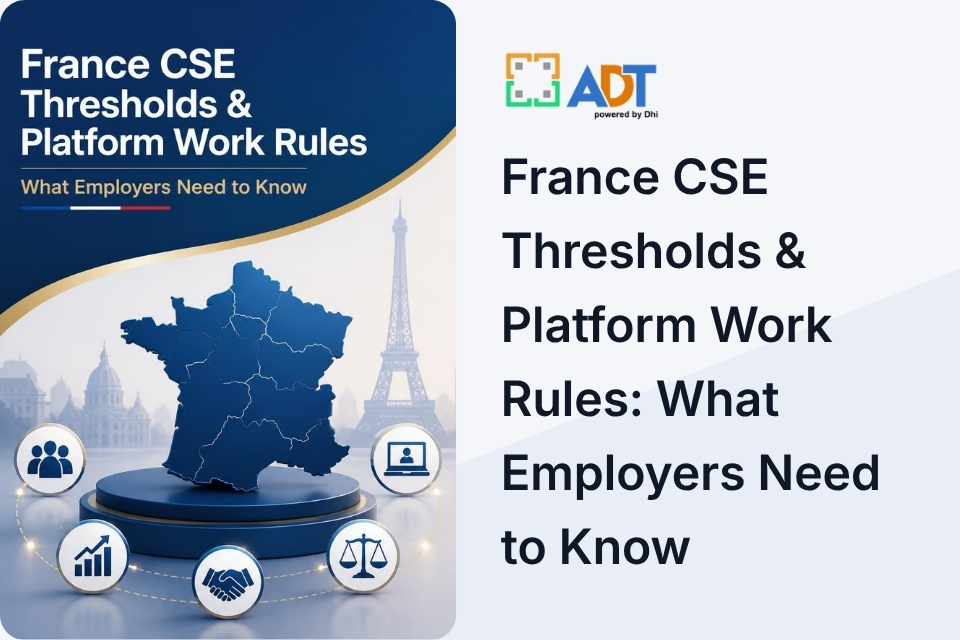

A finance lead in Paris pulls up the payroll report to prove there are only nine people. The report is correct. The answer is wrong.
Because France does not count employees the way your payroll does. Part-timers count as fractions. Fixed-term staff and agency workers count too, by the time they were actually there. Two temps who covered most of the year had pushed the real figure past eleven months ago and eleven is the number that requires a works council, once it holds for a year. Nobody sends a letter when the clock starts. You find out when someone asks.
That is the shape of the problem, and it shows up twice in French employment law. The works council threshold counts people you think of as flexible. The EU Platform Work Directive reaches relationships you think of as independent. Different laws, different purposes, no connection between them and the same question underneath: how many of these people are actually yours?
What is the works council threshold in France for employers?
Eleven employees, held for twelve consecutive months. That is Article L.2311-2 of the Labour Code, and it is worth knowing precisely, because both halves of that sentence do work.
Below eleven there is no obligation and no option either. A works council, the Comité Social et Économique or CSE, cannot be set up at all in a smaller company.
Two mechanics account for most of the surprises.
The count is not your payroll. Permanent full-time staff count as one each. Part-timers count by their contracted hours against the legal working week. Fixed-term and agency workers count by their time present, unless they are covering for someone absent, in which case they drop out entirely. Apprentices are generally excluded.
Run that through a real company and the arithmetic gets uncomfortable. Two half-timers make one. Two six-month contracts make one. Five agency workers present eleven months out of twelve make about 4.6. A business with nine names on payroll can be sitting at thirteen.
The clock resets. Eleven has to hold for twelve consecutive months without a break. Dip below once and the counter goes to zero. This is why seasonal businesses often stay outside the rule indefinitely and why a company hiring steadily crosses it without ever having a moment that feels like a threshold.
Once the twelve months are complete, you have ninety days from telling staff to run the election. And the door only swings one way: after a CSE exists, dropping back below eleven does not end anyone's mandate. Members serve four years.
What are the CSE requirements for companies hiring employees in France?
It is not one obligation. It changes character at fifty.
Between 11 and 49 employees, the CSE does what the old staff delegates did. It raises individual and collective claims about pay, the Labour Code and the applicable collective agreement, and it has a role in health and safety. Members get delegation hours around ten a month each at this size paid as working time.
From 50 employees, it becomes a different institution. It gains economic and strategic consultation rights, must be consulted on defined decisions, and can commission its own expert reports at the company's expense. It receives an operating budget of 0.2% of gross payroll, plus a separate budget for social and cultural activities.
A dedicated health and safety commission becomes mandatory in some cases and compulsory at 300. From January 2026, companies inside the corporate sustainability reporting rules also fold that information into the CSE's recurring consultations.
And if you skip it entirely. Under Article L.2317-1, obstructing the setting up of a CSE or the free designation of its members carries a year's imprisonment and a €7,500 fine. Obstructing its functioning carries the €7,500 without the prison term. For a company rather than an individual, the maximum multiplies by five to €37,500, with bans on professional activity available on top.
Notice which version is more serious. Never holding the election is the one that carries the prison sentence not mishandling a consultation afterwards. In France this is a criminal matter heard in the correctional court, not a compliance ticket.
How will the EU Platform Work Directive affect companies in France in 2026?
Now the second test, and France's position on it is one of the more interesting in Europe.
The Directive has to be in national law across the EU by 2 December 2026. Its engine is a rebuttable presumption: where the facts show direction and control, the relationship is presumed to be employment, and the company has to prove otherwise.
France has not transposed it, and this is not simple delay. France was one of two member states that opposed the Directive to the end. As of April 2026 no bill had reached the Council of Ministers. In February the government appointed a three-person consultation mission to work out what a workable transposition would even look like. By mid-2026 there was still no published text.
The reason is that France already built a different answer. The Social Relations Authority for Employment Platforms has produced a series of sector agreements since 2022, covering things like minimum earnings and how a commercial relationship can be ended. That system is designed around platform workers being independent. The Directive's presumption assumes the opposite starting point.
There is also a direct collision in the Labour Code. Article L.8221-6 presumes that a properly registered self-employed person is independent. Reconciling a domestic presumption of independence with a European presumption of employment is a genuine legal problem, not a scheduling one.
What it means for you in practice. French courts have applied a subordination test for decades, and the Directive's "direction and control" language sits very close to it. So companies engaging contractors in France are not waiting for a new risk. The risk already exists. What is changing is how easily someone can reach for it who can raise it, and who has to prove what.
France CSE requirements for international companies expanding their workforce
Three things that catch foreign employers specifically.
Your headcount is almost certainly higher than your payroll says. The usual mistake is counting permanent French staff and stopping there. Companies entering a market carefully through contractors, temps and part-time roles build up a statutory headcount they never see on a report. The cautious approach creates the exposure.
The twelve-month clock is invisible. No notification, no trigger, no letter. If you are anywhere between nine and thirteen people, the calculation has to be run monthly and written down, because the obligation attaches to a period you can only reconstruct after the fact.
The two tests feed each other, and this is the part worth sitting with. If contractors in France were ever reclassified as employees, they would count toward the CSE threshold as well assessed on the facts, not on the date you found out. One classification finding can produce a payroll liability and a separate criminal exposure for never having run an election. Neither test shows you that on its own. It only appears when you look at them together.
Most companies we talk to are surprised by their own number.
If you have French headcount, we'll run the statutory calculation with you and tell you where you actually sit. Fifteen minutes, and you'll know.
How to stay compliant with French employment law and platform work regulations
Four things, in order of urgency.
Calculate your effectif properly, and log it monthly. Permanent full-time at one, part-timers by contracted hours, fixed-term and agency by time present, replacements excluded. Keep the record. If you are anywhere near eleven, nothing else on this list matters as much.
Start preparing six to twelve months before you expect to cross. Elections mean informing staff, negotiating a pre-electoral agreement with unions, and running two rounds of voting. It does not compress. Even if nobody stands, you need a formal record of that, filed with the labour inspectorate within fifteen days of the second round.
Audit the contractors against the facts, not the contract. Who sets the rate, who sets the hours, who directs the method, whether they can send someone else, whether they have other clients. Worth doing now regardless of what happens in December, because the French test is already live.
Watch the transposition without waiting for it. France is consulting rather than legislating, so the eventual text is genuinely open. The question it will answer is not.
Bottom line
Two frameworks, nothing linking them, and the same way of going wrong.
Both count people you have already decided do not count. The works council threshold pulls in temps and fixed-term staff you think of as flexible capacity. The platform rules reach relationships you think of as commercial. In each case the law looks at a set of facts, and the company looks at a spreadsheet and the two disagree quietly for months before anyone notices.
The fix is smaller than it sounds. It is one number, calculated the statutory way rather than the payroll way, recorded every month. Most of the exposure here is not from getting a hard question wrong. It is from not knowing where you were standing.
Get in touch with us:
Netherlands (HQ) : +31 97010207974
UK (HQ) : +44 7401131349
Belgium : +32 460254634
Follow us on:
LinkedIn : https://www.linkedin.com/company/dhi-adt/


_1790144161.jpg)








 experts@adtsolution.com


 Queens towers, Delflandlaan 1, 1062 EA Amsterdam, The Netherlands



Comments (0)
No comments yet. Be the first to comment!