 AUG (Authorized User Group) Certified
 IND-recognised sponsor
 Nasscom Certified
 SNA Certified

Luxembourg is a small country with an outsized role in European hiring strategy. It is the EU's financial services capital, home to the bloc's key institutions, and uniquely among the countries in this guide series a labour market where nearly half the workforce crosses a national border every morning to get to work. For a foreign company opening its first Luxembourg role, this creates a genuinely different set of planning questions than hiring in Germany, France, or the Netherlands.
This guide is written for HR directors, CFOs, and founders evaluating a first hire, a regional headquarters function, or a small team in Luxembourg. It covers the legal framework, wage indexation (the mechanic that catches almost every foreign employer off guard), payroll and social contributions, severance and notice rules, immigration routes for non-EU hires, and the EOR vs own-entity decision.
Why Luxembourg Is a Different Kind of Hiring Decision
Luxembourg's employment framework is, on paper, less procedurally dense than Germany's or Italy's. There is no equivalent of Italy's 900-plus CCNL system determining your baseline terms, and collective bargaining agreements only bind you if you're a signatory, part of a sector under a mandatory agreement, or part of a group already covered a narrower reach than in Italy or the Netherlands.
What makes Luxembourg distinctive instead is structural. Roughly 47% of the private-sector workforce are cross-border workers (frontaliers) commuting daily from France, Belgium, and Germany meaning a meaningful share of any Luxembourg hire's tax residency, social security affiliation, and telework arrangements are governed by cross-border coordination rules, not purely domestic law. Layered on top of that is automatic wage indexation: a statutory mechanism that adjusts virtually all salaries in the country in lockstep with inflation, on a schedule the employer does not control.
None of this makes Luxembourg a hard market to hire in it has one of the more straightforward payroll cost structures in Western Europe, as you'll see below. It means the planning questions are different from the ones you'd ask about Germany or France, and worth understanding before the first offer letter goes out.
The Legal Framework
Luxembourg employment law is codified primarily in the Code du Travail (Labour Code), which governs contracts, working time, leave, termination, and collective relations in a single consolidated code a notable contrast to Germany's framework, which is spread across several separate statutes (BGB, KSchG, ArbZG, and others).
Social security law sits in a separate Code de la Sécurité Sociale, administered jointly by the Centre commun de la sécurité sociale (CCSS), the Caisse Nationale de Santé (CNS, health insurance), and the Caisse nationale d'assurance pension (CNAP, pension).
Collective bargaining agreements (conventions collectives de travail, CCTs) apply to a company in three scenarios: the company is a direct signatory; the company falls within a sector where a CCT has been declared generally binding (obligatoire) by grand-ducal regulation; or the company is part of a group or economic entity already covered by a CCT. Sectors with well-established CCTs include banking, insurance, and hospitality finance and tech roles outside those specific sectors frequently have no applicable CCT at all, which puts more weight on the individual employment contract than in Italy or France.
Staff delegation (délégation du personnel): Any company employing 15 or more people (measured over the 12 months preceding the reference date for elections) must organise staff delegate elections under the Code du Travail. Once elected, the delegation has information and consultation rights over dismissals, workforce restructuring, and working conditions a lighter-touch equivalent of Germany's Betriebsrat, triggered at a lower headcount.
Wage Indexation: Luxembourg's Defining Payroll Mechanic
This is the feature of Luxembourg payroll that most foreign employers don't discover until it happens to them.
Nearly all wages in Luxembourg the statutory minimum wage, and by extension most salary scales, pensions, and many contract values are linked to a national cost-of-living index. When the six-month moving average of inflation crosses a defined trigger threshold (currently 2.5%), every indexed wage in the country rises by the same percentage, automatically, on the same date, across the entire economy. This isn't a one-off statutory increase like a minimum wage review; it recurs whenever inflation conditions trigger it, which in recent years has meant roughly one to two adjustments per year.
What this means practically: an employer cannot treat a Luxembourg salary as a fixed number in a financial model. Budget planning needs to build in an indexation buffer, because the increase applies to the whole payroll simultaneously and is not negotiable or optional at the individual employer level.
-
Unqualified statutory minimum wage (SSM): €2,771.33/month (€16.0192/hour), index 992.24, effective 1 June 2026
-
Qualified statutory minimum wage (120% of unqualified): €3,325.60/month (€19.2230/hour)
-
STATEC does not project a further automatic indexation before Q3 2026 at the earliest, so these figures should hold for now — but confirm again before finalising any offer, since the whole point of indexation is that it isn't on a fixed calendar.
Employment Contracts
Contrat à Durée Indéterminée (CDI) - indefinite contract: The standard form, used for any role meeting an ongoing business need. No end date; full termination protection applies once the trial period ends.
Contrat à Durée Déterminée (CDD) - fixed-term contract: Permitted only for genuinely temporary needs (replacing an absent employee, a seasonal spike, a specific time-limited project) - not as a general-purpose alternative to a CDI. A CDD can be renewed up to twice, but the total duration including renewals cannot exceed 24 months. A CDD that runs longer, or is renewed a third time, is automatically reclassified as a CDI. Employees on a CDD accrue the same statutory entitlements (leave, sick pay protections) as CDI employees fixed-term status does not reduce employer obligations, the same principle that applies in Italy and Germany.
Trial period (période d'essai): Must be set out in writing to be valid. Minimum duration is two weeks; maximum duration depends on the role's qualification level and can extend up to twelve months for positions requiring a diploma-level qualification
Contract language: Employment contracts are commonly drafted in French, though German and English are widely used in international and financial-sector employment relationships. There is no strict legal requirement that the contract be in Luxembourgish, French, or German specifically, but in the event of a dispute before the labour courts, a French-language version is the safer default.
International Hiring: Immigration for Non-EU Workers
EU, EEA, and Swiss nationals can work in Luxembourg without a permit, though they must register with their local commune within three months of arrival. Third-country nationals need both a residence permit and work authorisation before starting.
EU Blue Card (Carte bleue européenne): The primary route for highly qualified non-EU hires. Following a Ministerial Regulation of 23 February 2026, the minimum gross annual salary threshold rose to €65,652, effective for applications submitted from 3 March 2026 onward (applications filed before that date continue to be assessed against the prior €63,408 threshold)
Eligibility requires a university degree (or five years of equivalent specialised professional experience) and an employment contract of at least six months. Blue Card holders gain free labour-market access after 12 months (versus 2 years under the standard route), a card valid for up to four years or the contract length plus three months, and eligibility to move to another EU Blue Card country under simplified terms after 18 months.
Salaried Worker Permit: For roles below the Blue Card threshold, the employer applies for a standard work permit, which requires completing a labour market test demonstrating that no suitable candidate was available on the Luxembourg or EU labour market before hiring the third-country national.
Fees: The residence permit application fee is approximately €80 across categories; the long-stay Type D visa processed at the consulate is approximately €50. Employers face administrative fines for employing a worker without valid authorisation.
The cross-border alternative: Because roughly 47% of Luxembourg's workforce already commutes from France, Belgium, or Germany, many employers fill roles with EU nationals resident just across the border rather than sponsoring non-EU immigration at all worth factoring into a hiring-speed comparison before committing to a Blue Card process that can take several weeks to a few months to complete.
Cross-border telework thresholds (for any employee who is a frontalier): Under EU coordination rules, a cross-border employee can telework up to 25% of their working time from their country of residence without their social security affiliation shifting away from Luxembourg extended to 49.9% under a multilateral framework agreement in effect since 1 July 2023, provided the employer files the relevant declaration. Separately, bilateral tax treaties with France, Belgium, and Germany set a tolerance threshold commonly cited at 34 days per year beyond which income for days worked outside Luxembourg becomes taxable in the employee's country of residence rather than in Luxembourg.
Payroll in Luxembourg: What You Actually Pay
This is where Luxembourg diverges most sharply from Italy and Germany total employer social contributions are meaningfully lower.
Employer social security contributions (rates effective 1 January 2026):
|
Contribution branch |
Employer rate |
|
Health insurance (maladie-maternité) |
3.05% |
|
Pension insurance |
8.50% |
|
Accident at work |
0.65% base × bonus-malus factor (range: 0.5525%–0.975%) |
|
Occupational health (santé au travail) |
0.14% |
|
Employer Mutuality (sick-pay reimbursement fund) |
0.23%–2.66%, by company absenteeism class (4 classes) |
Adding these together, total employer social contributions typically land in the ~12.4%–15.3% of gross salary range, depending on your accident-insurance risk class and absenteeism history well below Germany's ~21–23% and far below Italy's ~27–30% INPS rate. This is the single most consistently surprising fact for employers comparing Luxembourg to its neighbours: the headline cost of living and salaries is high, but the statutory payroll burden on top of gross salary is comparatively light.
Pension contributions increased under a January 2026 reform: the total pension contribution rate rose from 24% to 25.5% of gross salary, split equally three ways between employer (8.5%), employee (8.5%), and the state (8.5%) up from 8% each previously. This rate is fixed through 2032 under the reform legislation.
Contribution ceiling: Following the 1 June 2026 indexation to index 992.24, the SSM itself rose to €2,771.33/month, and since the ceiling is statutorily defined as exactly 5× the SSM, the ceiling now calculates to approximately €13,856.65/month (~€166,280/year). This is a derived figure based on the statutory formula rather than one independently confirmed by a source restating the ceiling at the new index worth a final confirmation with CCSS or a Luxembourg payroll provider before use in a live payroll run. Dependency (long-term care) insurance remains the exception it applies to total income with no ceiling.
No mandatory 13th month: Unlike Italy, where the tredicesima is a universal statutory obligation, Luxembourg law grants no automatic right to a 13th-month salary. It becomes mandatory only if provided by the individual employment contract, an applicable CCT, or an established company custom that is constant, general, and fixed in amount over time (a Luxembourg legal doctrine called usage). It is common practice in banking, insurance, and some other sectors, but it is not a default employer obligation the way it is in Italy.
Total Employer Cost: A Practical Example
For an employee on €70,000 gross annual salary, outside any CCT, with a neutral bonus-malus factor (1.0) and Employer Mutuality Class 2:
|
Component |
Annual cost |
|
Gross salary |
€70,000 |
|
Employer pension contribution (8.50%) |
€5,950 |
|
Health insurance (3.05%) |
€2,135 |
|
Accident at work (0.65% base, neutral factor) |
€455 |
|
Occupational health (0.14%) |
€98 |
|
Employer Mutuality (Class 2, 0.95%) |
€665 |
|
Total employer cost |
~€79,303 |
The effective employer cost multiplier for Luxembourg is approximately 113–116% of gross salary for a role without a 13th month or CCT-mandated extras meaningfully lower than the ~120–125% typical in Germany and well below Italy's ~130–140%. Where a CCT or company custom adds a 13th month or additional allowances, the multiplier rises accordingly, but the underlying statutory contribution burden stays the lightest of the three markets covered in this guide series.
Annual Leave and Working Hours
Statutory minimum annual leave: 26 working days per year (based on a 5-day week) notably higher than Germany's 20-day statutory floor and above Italy's 20-day minimum. Many sectors and CCTs provide more.
Working hours: Standard legal working week is 40 hours, 8 hours per day. Overtime is regulated and generally requires either a premium payment or compensatory rest, subject to the applicable CCT or Code du Travail provisions.
Sick Leave
Employer continued-pay obligation: The employer must continue paying the employee's full salary during illness or occupational accident until the end of the calendar month in which the 77th day of sick leave falls, calculated over a rolling 18-month reference period. From the start of the following month, the Caisse Nationale de Santé (CNS) takes over payment of sickness benefits directly, and the employer's salary obligation ends.
This is more generous to the employer than Germany's flat six-week rule in one respect it's measured cumulatively across an 18-month window rather than resetting per illness but it can also run considerably longer than six weeks before the state fund takes over, depending on how the 77 days accumulate.
Employer Mutuality offset: The Employer Mutuality (Mutualité des employeurs) reimburses employers 80% of the salary cost (gross pay plus employer contributions) paid during this continued-pay period a direct, quantified offset that has no equivalent in Germany or Italy. This is arguably Luxembourg's most distinctive sick-leave feature: employers are not simply absorbing the full cost of an employee's continued-pay period the way they are in most European systems.
Extended incapacity: If incapacity continues beyond the employer's continued-pay obligation, CNS sickness cash benefits run for up to 78 weeks within a 104-week reference period.
Maternity leave: Covered separately under the same health insurance branch, with benefits paid by the CNS.
Termination in Luxembourg
Termination outcomes in Luxembourg hinge on a single number: five years of service.
Notice periods and severance by length of service (Article L.124-7 of the Labour Code):
|
Length of service |
Notice period |
Severance allowance |
|
Less than 5 years |
2 months |
None |
|
5 to under 10 years |
4 months |
1 month |
|
10 to under 15 years |
6 months |
2 months |
|
15 to under 20 years |
6 months |
3 months |
|
20 to under 25 years |
6 months |
6 months |
|
25 to under 30 years |
6 months |
9 months |
|
30 years or more |
6 months |
12 months |
Severance is calculated on the average monthly wage over the 12 months preceding the termination notification, and is payable at the end of the notice period regardless of whether the notice was actually worked. It is not subject to income tax or social contributions.
No payment in lieu of notice: Unlike many jurisdictions, Luxembourg does not allow an employer to simply pay out the notice period and end employment immediately the notice period must be observed and worked, or formally extended, as set by law or the applicable CCT. This is a real operational constraint: an employer cannot buy out a departing employee's notice the way they routinely can in the UK or the US.
The small-employer alternative: Companies with fewer than 20 employees may, at the point of dismissal, choose to extend the notice period instead of paying severance for employees dismissed for economic reasons with more than five years of service. The extended notice periods run considerably longer than the standard notice table above, so this is a genuine trade-off between cash cost and time, not a discount option.
Gross misconduct (faute grave): Allows immediate dismissal without notice or severance, but the bar is high, and the employer must be able to substantiate serious grounds if challenged before the labour courts (Tribunal du travail).
Procedural requirement: Before a dismissal with notice, Luxembourg law generally requires the employer to hold a preliminary meeting (entretien préalable) with the employee, and to notify the dismissal by registered mail or hand delivery with acknowledgment of receipt. Skipping the correct notification procedure can expose the employer to a claim for irregular dismissal, separate from any dispute over the substantive grounds.
Setting Up to Hire in Luxembourg: What You Need in Place
-
Applicable CCT status confirmed — signatory, sector-mandated, or none applicable
-
Employment contract drafted (French recommended as the safer default for enforceability; German or English commonly used in practice)
-
Company registered with the Centre commun de la sécurité sociale (CCSS) for social contributions
-
Employer Mutuality class confirmed (determines sick-pay reimbursement rate)
-
Accident-at-work bonus-malus rate confirmed with the Association d'assurance accident
-
Payroll system configured with current index level and contribution ceiling
-
Staff delegation obligations checked if headcount is approaching or above 15
-
For cross-border hires: telework percentage and tax tolerance-day thresholds documented against the employee's country of residence
-
For non-EU hires: Blue Card salary threshold confirmed against the offer, or labour market test initiated for the Salaried Worker Permit route
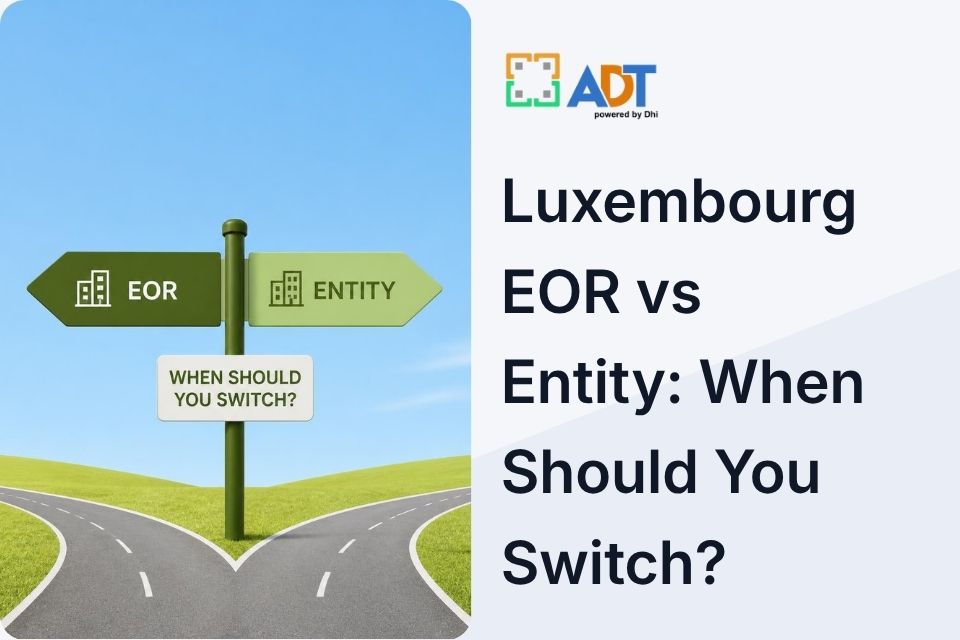
EOR vs Own Luxembourg Entity: The Core Decision
Establishing a Luxembourg Sàrl (société à responsabilité limitée):
-
Minimum share capital: €12,000, fully subscribed and paid up at incorporation under current rules
-
A legislative proposal (Projet de loi n° 8669) previously described as "under consideration" has since passed: it was adopted in first vote by the Chamber of Deputies on 28 April 2026, the Council of State granted a dispensation from the second constitutional vote on 5 May 2026, and it was enacted as the law of 18 May 2026, entering into force on 2 June 2026. Practical effect: founders must still fully subscribe the €12,000 minimum capital at incorporation, but full payment of it can now be deferred, in whole or in part, for up to 12 months after incorporation, under an optional regime that applies to both Sàrl and Sàrl-S. Safeguards include suspended voting rights on unpaid shares, enhanced founder liability for ensuring the capital is actually paid in, and mandatory disclosure of which shareholders still owe unpaid amounts. This applies to both standard Sàrl and simplified Sàrl-S structures.
-
Notary-based incorporation process: typically 3–4 weeks from name reservation to full registration with the Registre de Commerce et des Sociétés (RCS)
-
A business establishment authorisation (autorisation d'établissement) from the Ministry of the Economy is required for most commercial activities
-
Ongoing obligations: annual accounts filing, corporate tax compliance, and depending on size a statutory auditor requirement
Using an Employer of Record:
-
No Luxembourg entity required the EOR is the legal employer under Luxembourg law
-
Employment can typically begin within 1–2 weeks rather than 3–4+ weeks
-
CCSS registration, payroll, indexation tracking, Employer Mutuality classification, and staff delegation thresholds are managed by the EOR
-
Particularly relevant for companies testing the Luxembourg market with cross-border hires, where the EOR's existing familiarity with frontalier tax and social security coordination rules removes a genuine layer of first-hire complexity
The crossover point: Given Luxembourg's comparatively light statutory payroll burden, the headcount at which a direct entity becomes financially rational is typically in the 8–12 employee range for most company profiles somewhat lower than the 10–15 employee crossover typical in Germany and the Netherlands, largely because Luxembourg's ongoing compliance overhead is lighter once the entity exists. This estimate does not depend on the capital-deferral bill above passing.
Luxembourg vs Netherlands vs Germany: A Three-Market Comparison
|
Netherlands |
Germany |
Luxembourg |
|
|
Collective agreement system |
CAO — sector-wide, often automatically binding |
Tarifvertrag — binding if member or declared generally binding |
CCT — binds signatories, mandated sectors, or covered groups only; narrower reach |
|
Mandatory severance / deferred comp |
Transitievergoeding: statutory from day 1, ~1/3 month per year |
Abfindung: not statutory, negotiated in practice |
Indemnité de départ: statutory only after 5 years' service |
|
Sick leave (employer obligation) |
Up to 2 years at 70% + reintegration obligations |
6 weeks at 100% |
Full pay until end of month of 77th sick day (18-month reference period), 80% reimbursed by Employer Mutuality, then CNS |
|
Dismissal protection |
Strong — transitievergoeding always due |
Strong — KSchG, reinstatement or financial indemnity |
Moderate — notice-based, severance only after 5 years, no payment in lieu of notice |
|
Total employer cost multiplier |
~130–135% of gross |
~120–125% of gross |
~113–116% of gross (lighter, absent CCT extras) |
|
Wage mechanism |
Standard negotiated increases |
Standard negotiated increases |
Automatic index-linked adjustments, economy-wide |
|
Distinctive workforce feature |
Domestic + EU talent pool |
Domestic + Blue Card immigration |
~47% cross-border workforce (FR/BE/DE) |
|
Special expat tax benefit |
30% ruling — 30% tax-free for 5 years |
None |
None equivalent; cross-border tax treaties instead |
|
EOR crossover point |
10–15 employees |
10–15 employees |
8–12 employees |

 Blue Card, Anmeldung & Netherlands Comparison_1788936018.jpg)










 experts@adtsolution.com


 Queens towers, Delflandlaan 1, 1062 EA Amsterdam, The Netherlands



Comments (0)
No comments yet. Be the first to comment!