 AUG (Authorized User Group) Certified
 IND-recognised sponsor
 Nasscom Certified
 SNA Certified
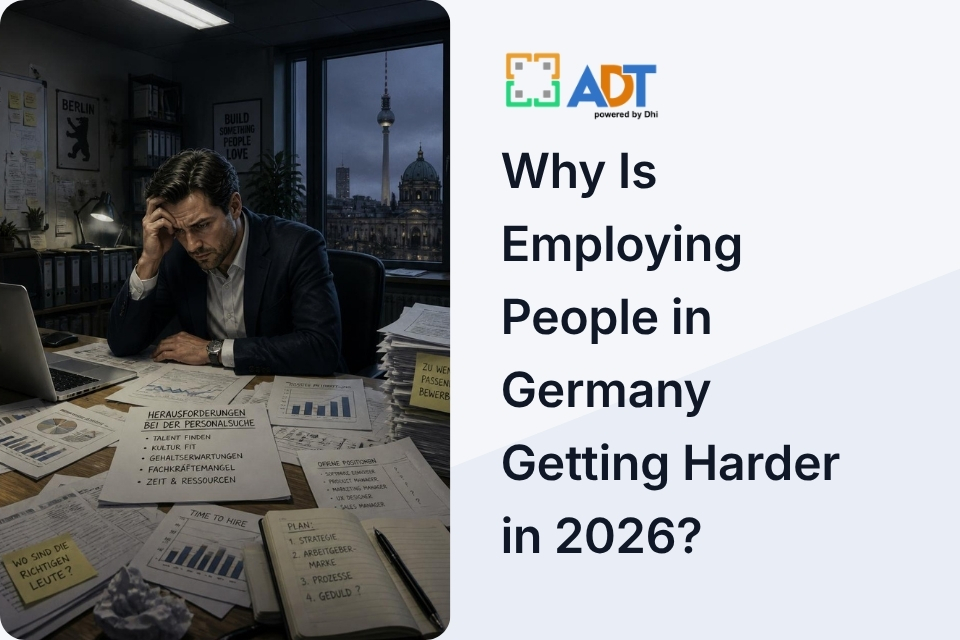

Most foreign companies treat German hiring as a paperwork problem. Get the contract right, register with the right offices, run payroll properly, done.
That was mostly true until this year. The rules themselves haven't been rewritten. What happened is that four separate numbers moved within the same twelve months and three of them are tied to figures the government updates each January, not to anything you control.
If you're an HR Director, CFO, Founder, or Legal lead planning German hires in the next two quarters, these are the five questions that decide whether your plan still works. In each case, the 2026 answer is different from last year's.
How Do You Hire Employees in Germany Legally?
You need three things before anyone starts: a proper employment contract, registration with the social insurance system, and a payroll setup that deducts and pays the right amounts.
The contract rules got easier in one way and stayed strict in another. Since 1 January 2025, employers can give the main contract terms in text form email or paper instead of needing a hand-signed copy. This makes fully digital onboarding possible for permanent roles.
The employee must be able to open, save and print the document, and you must ask them to confirm they received it. Fixed-term contracts and termination letters are the main exceptions, and still need a signed paper version. The law that lists what must be documented (Nachweisgesetz) carries fines of up to €2,000 for each breach.
That exception trips people up. If you've moved everything to e-signature and then issue a fixed-term contract the same way, the end date usually won't hold. You're left with a permanent employee you didn't plan to hire.
On registration, a foreign employer needs a company number (Betriebsnummer) from the Federal Employment Agency, has to register employees for pension, health, unemployment and long-term care insurance, register with the right accident insurance body (Berufsgenossenschaft), and run German payroll with monthly and annual reporting.
One more duty is already live, though many companies think it's still coming. Since a Federal Labour Court ruling in September 2022, all working time has to be recorded for every employer, in every industry, from the first employee. A draft law to write this properly into the Working Time Act has been under discussion since 2023 and still hasn't passed, so the court ruling is what applies. Breaking the Working Time Act can cost up to €30,000 in fines.
The law hasn't arrived. The obligation already has.
Do You Need a German Legal Entity to Hire Employees?
No. But the three options aren't equal, and the middle one is the one people misread.
Set up a German company (GmbH). This needs €25,000 in share capital, with at least €12,500 paid in at the start, plus notary work, trade and tax registrations, and a German bank account. For a foreign parent, it usually takes two to six months before payroll can run, and you need local accounting help from day one.
Register as a foreign employer for payroll only. You can pay German employees this way without setting up a company, but German wage tax rules, employment law and social security duties still apply in full. The problem is what this route doesn't cover. Employees usually have to settle their own wage tax directly with the tax office through their annual return, and as your headcount or the seniority of your roles grows, there's a risk the tax authorities treat you as having a taxable presence in Germany which brings corporate tax duties with it.
Use an Employer of Record (EOR). The EOR employs the person in Germany on your behalf. You direct the work.
The common mistake is treating payroll-only registration as a lighter version of an entity. It removes the company setup step, not the employer duties. It also pushes a tax admin job onto the employee, which is a hard thing to explain when you're competing for candidates.
What Payroll Taxes and Employer Costs Apply in Germany?
Budget roughly 120–125% of gross salary. The reason to recheck that this year is that the amount of salary those percentages apply to went up, even where nobody got a raise.
The 2026 rates stayed the same: pension at 18.6%, general health insurance at 14.6%, long-term care at a 3.4% base, and unemployment at 2.6% each split between employer and employee.
What changed were the income ceilings. Social contributions are only charged up to a cap. For health and long-term care, that cap rose from €66,150 to €69,750 a year. For pension and unemployment, it rose from €96,600 to €101,400 a year (€8,450 a month). The average top-up health contribution also rose, from 2.5% to 2.9%.
So if an employee earns below both caps, nothing changed. If they earn between the old cap and the new one, more of their salary is now charged meaning they cost you more at exactly the same salary. That's the item most 2026 budgets missed, because it doesn't look like a rate change.
The bottom of the pay scale moved too. According to the Federal Ministry of Labour, the minimum wage rose to €13.90 gross per hour on 1 January 2026, and goes up again to €14.60 on 1 January 2027. The earnings limit for small part-time jobs (Minijob) is linked to it and now sits at €603 a month.
Accident insurance sits on top of the four main contributions and varies by industry, which is why a single exact figure isn't possible. The 120–125% range is the honest answer.
What Employment Laws Must Every Employer Follow?
Three that change as you grow, and one that's currently in a gap.
Dismissal protection starts at a specific headcount. The Dismissal Protection Act (Kündigungsschutzgesetz) applies once two things are true at the same time: the company employs more than 10 people, and the employee has been there at least six months. Part-time staff count as a fraction up to 20 hours a week counts as 0.5, up to 30 hours as 0.75. Below that line, you can end employment on two weeks' notice during probation without giving a substantive reason. Above it, a dismissal has to be justified on one of three legal grounds.
Notice periods grow with length of service. The starting point is four weeks, ending on the 15th or the last day of a month. It then rises to one month after two years, two months after five, three after eight, four after ten, and up to seven months after 20 years. If there's a works council (Betriebsrat), you have to consult it before dismissing someone and skipping that step makes the dismissal invalid.
Visa salary thresholds went up in January. The EU Blue Card minimum for 2026 is €50,700 gross a year for standard roles, and €45,934.20 for shortage occupations and recent graduates. Both took effect on 1 January 2026, about 5% above 2025, because the thresholds are linked to the pension contribution ceiling. An offer agreed in late 2025 just below those figures can now be refused unless you raise the salary. Processing usually takes 6 to 12 weeks from the date the application is submitted at the embassy or consulate.
Pay transparency is the gap. Germany missed the 7 June 2026 deadline to bring the EU Pay Transparency Directive into national law, and hadn't published a draft at that point. Across the EU, the first gender pay gap reports are due on 7 June 2027, based on 2026 pay data data your German payroll is producing right now. There's no German obligation today. The data window is already open.
When Should You Choose an Employer of Record Instead of Opening an Entity?
An EOR is usually the right choice for your first one to ten German hires. After that it becomes a maths question, and the switch-over point tends to sit somewhere around 10 to 15 employees, depending on how much fixed overhead an entity costs you.
Three situations where staying with an EOR longer makes sense:
You're hiring from outside the EU. The visa salary threshold and the processing time are the two things most likely to break a hiring plan, and neither is in your control. Running this in-house means checking thresholds at every renewal, not just at hire.
You're approaching 10 German employees without a legal team in Germany. Crossing that line changes what it costs to end a hire that isn't working, and nothing in your HR system will tell you when it happens.
You're still testing the market. Setting up a company takes two to six months before the first person can start. An EOR can usually have someone on payroll in one to three weeks.
The case for your own entity is real too: full control over bonus schemes, share plans and HR policy, a registered presence where clients or regulators care about that, and better economics once you have enough people to absorb the fixed costs. It just shouldn't be the default choice because it worked in your last market.
Bottom Line
German employment law wasn't rewritten this year. What happened is that the minimum wage, the social contribution ceilings and the Blue Card threshold all moved on 1 January, an EU deadline passed with no German law behind it, and a working time duty that's been binding since 2022 is still widely treated as optional.
On their own, none of these is dramatic. Together, they mean a German hiring model built in late 2025 is probably wrong on cost and possibly wrong on visa eligibility for anyone hired close to the threshold.
Three numbers now need checking every year: your employer cost multiplier, the Blue Card threshold, and your headcount against the dismissal protection line. The rest of German employment law is stable enough to learn once.
If you want to work through what a German hire really costs and what your growth plan implies, we're happy to go through the numbers with you. Reach the team at experts@adtsolution.com
Get in touch with us:
Netherlands (HQ) : +31 97010207974
UK (HQ) : +44 7401131349
Belgium : +32 460254634
Follow us on:
LinkedIn : https://www.linkedin.com/company/dhi-adt/


 Blue Card, Anmeldung & Netherlands Comparison_1788936018.jpg)









 experts@adtsolution.com


 Queens towers, Delflandlaan 1, 1062 EA Amsterdam, The Netherlands



Comments (0)
No comments yet. Be the first to comment!