 AUG (Authorized User Group) Certified
 Nasscom Certified
 SNA Certified
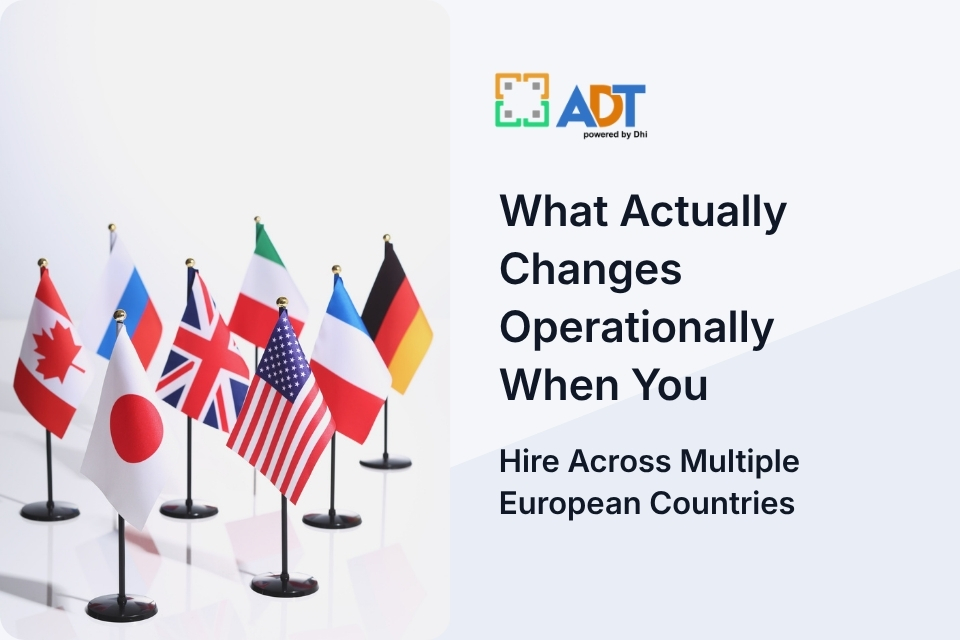
What Actually Changes Operationally When You Hire Across Multiple European Countries
Hiring one employee in Europe can feel straightforward
Hiring across three or four European countries at the same time is where companies begin to understand that international hiring is not really a recruiting challenge. It is an operational one.
At first, the complexity is easy to miss. A company hires someone in the Netherlands through an Employer of Record. Then another person joins remotely from Germany. A contractor in Spain later becomes a full-time employee. Payroll gets routed through different providers. HR begins managing country-specific documents manually. Finance starts tracking employer costs in separate spreadsheets.
Nothing appears broken initially. In fact, most teams feel they are moving quickly.
The operational strain usually appears later — when the company grows, when systems stop aligning, or when a local regulation suddenly forces a decision nobody internally owns.
This is one of the biggest realities of scaling teams across Europe. The challenge is rarely one hire. The challenge is what happens when hiring becomes an interconnected system across multiple countries.
At Dhi ADT, this is the point where most conversations with founders, HR leaders, and finance teams begin.
The First Country Feels Simple. The Third Country Changes Everything
Most companies entering Europe underestimate how quickly operational complexity compounds.
The first hire often feels manageable because the process is still contained. Teams can coordinate manually. Payroll can be handled through one local setup. HR and finance are still closely aligned.
The third or fourth country changes the nature of the problem completely.
Suddenly, the company is dealing with:
-
different payroll cycles,
-
different tax structures,
-
different employment protections,
-
country-specific benefits,
-
onboarding requirements,
-
reporting obligations,
-
and local compliance expectations that do not behave the same way.
This is where international hiring operations begin to mature from isolated activities into a workforce infrastructure problem.
Many companies continue approaching each country independently for too long. Operationally, that creates fragmentation very quickly.
Payroll Becomes More Complex Than Most Teams Expect
One of the biggest operational shifts during European expansion is payroll.
Companies often assume payroll is mostly administrative. In reality, multi-country payroll becomes one of the central operational systems inside international growth.
Every country introduces its own variables:
-
tax calculations,
-
social contributions,
-
employer obligations,
-
statutory leave structures,
-
reporting deadlines,
-
payslip requirements,
-
and termination-related payouts.
Even neighboring countries can function very differently.
The Netherlands, Germany, Belgium, and France may all sit within Europe, but payroll operations across those markets do not behave uniformly. A process that works cleanly in one country may create compliance gaps in another.
This becomes especially difficult when companies expand quickly without standardizing how payroll data moves internally between HR, finance, legal, and local providers.
Over time, teams often find themselves dealing with:
-
disconnected payroll systems,
-
inconsistent reporting structures,
-
manual reconciliation work,
-
delayed approvals,
-
and limited visibility across total workforce costs.
At that stage, payroll is no longer just a finance function. It becomes an operational coordination challenge across the business.
Employment Laws Across Europe Are Deeply Local
A common misconception in global expansion is that Europe behaves like one unified employment market.
Operationally, it does not.
European employment laws remain highly country-specific. Local expectations around hiring, termination, probation periods, employee protections, leave entitlements, contractor classification, and working conditions can vary significantly.
Some countries have:
-
stronger employee protection frameworks,
-
more rigid termination rules,
-
mandatory collective agreements,
-
or stricter contractor scrutiny.
Others allow more flexibility operationally.
The issue is not simply understanding the law itself. The challenge is how those laws affect day-to-day operational decisions.
For example:
-
how quickly a role can be filled,
-
how onboarding timelines behave,
-
what documentation is required,
-
how payroll must be structured,
-
or how difficult workforce restructuring becomes later.
This is why companies hiring across Europe often realize they need much deeper local compliance awareness than they initially expected.
Not because Europe is impossible to navigate, but because workforce operations remain deeply local even inside a global business.
Most International Hiring Problems Start as Coordination Problems
One of the most overlooked operational realities in European workforce management is this:
The biggest issues rarely come from one dramatic compliance mistake.
Most problems begin as coordination gaps.
A finance team may approve a hiring structure without full visibility into local employment implications. HR may onboard employees through one process while payroll operates through another. Legal teams may review contracts without visibility into how the role actually functions operationally.
Initially, these gaps seem manageable.
As hiring scales, they begin creating friction:
-
onboarding delays,
-
payroll inconsistencies,
-
reporting confusion,
-
contractor classification exposure,
-
and uncertainty around who internally owns workforce compliance decisions.
The companies that scale more smoothly across Europe usually solve this earlier than expected.
They build operational clarity before the organization becomes too dependent on fragmented systems.
Do Companies Need a Legal Entity in Every European Country?
Not always.
This is one of the most common questions companies ask during international expansion.
In many situations, companies can hire employees in Europe without immediately setting up a local legal entity by using an Employer of Record (EOR).
An EOR allows companies to:
-
employ talent compliantly,
-
manage local payroll,
-
handle country-specific employment requirements,
-
and enter new markets more quickly.
For companies testing a market or making early hires, this often creates much more operational flexibility.
However, as teams grow, workforce structure usually evolves.
At some stage, companies may decide to establish local entities because:
-
team size increases,
-
operational control becomes more important,
-
local revenue grows,
-
or long-term workforce planning changes.
The important point is that EOR and entity structures solve different phases of international growth.
The strongest companies usually treat workforce structure as something that evolves over time — not as a one-time decision.
The Teams Involved in International Hiring Expand Quietly
Many organizations initially think global hiring belongs mostly to HR.
In practice, international hiring operations quickly become cross-functional.
As European expansion grows, the following teams usually become deeply involved:
-
HR,
-
finance,
-
payroll,
-
legal,
-
operations,
-
leadership,
-
and sometimes mobility or immigration teams.
This is because workforce operations affect much more than hiring itself.
They influence:
-
financial planning,
-
compliance exposure,
-
workforce structure,
-
operational scalability,
-
and long-term expansion strategy.
One of the clearest signals of operational maturity is how aligned these teams become during international growth.
The companies that struggle most are often not lacking talent or ambition. They simply allowed operational ownership to remain fragmented for too long.
The Biggest Operational Mistake Companies Make During European Expansion
The biggest mistake is usually waiting too long to introduce structure
Many companies operate successfully for months using manual coordination and country-by-country decision-making. That approach often works early because the organization is still small enough to absorb operational inefficiencies.
The problem is that complexity compounds quietly.
By the time operational strain becomes visible:
-
payroll systems are fragmented,
-
contractor structures are inconsistent,
-
onboarding workflows vary by country,
-
and internal teams are spending significant time managing exceptions manually.
At that point, restructuring becomes much harder.
The companies that scale international teams most effectively tend to think operationally earlier than expected.
They standardize:
-
hiring workflows,
-
payroll visibility,
-
compliance ownership,
-
reporting structures,
-
and workforce decision-making before growth forces urgency.
That early operational clarity becomes a competitive advantage later.
European Expansion Is Becoming an Operational Discipline
A few years ago, many companies approached European hiring as an expansion experiment.
Today, the conversation is changing.
Founders, CFOs, HR leaders, and operators are thinking much more seriously about:
-
international payroll compliance,
-
workforce structure,
-
contractor risk,
-
scalability,
-
and operational maturity.
The companies succeeding across Europe are usually not the ones moving recklessly fast.
They are the ones building systems that can absorb complexity without slowing growth.
That shift is becoming increasingly important as:
-
workforce regulations evolve,
-
payroll compliance expectations increase,
-
and cross-border hiring becomes more operationally interconnected.
Final Thought
Hiring internationally across Europe does not become difficult because one country is impossible to navigate.
It becomes difficult when companies continue treating every new hire as an isolated event instead of part of a growing operational system.
The operational layer underneath global hiring eventually becomes visible in every scaling company.
The question is usually whether that realization happens early — or after the friction has already started affecting growth.
Dhi ADT helps companies hire, pay, and stay compliant across Europe and 50+ countries globally through EOR, global payroll, workforce compliance, and international hiring operations support.
Get in touch with us:
Netherlands (HQ) : +31 97010207974
UK (HQ) : +44 7401131349
Belgium : +32 460254634
Follow us on:
LinkedIn : https://www.linkedin.com/company/dhi-adt/

_1790144161.jpg)






 experts@adtsolution.com


 Queens towers, Delflandlaan 1, 1062 EA Amsterdam, The Netherlands



Comments (0)
No comments yet. Be the first to comment!