 AUG (Authorized User Group) Certified
 Nasscom Certified
 SNA Certified
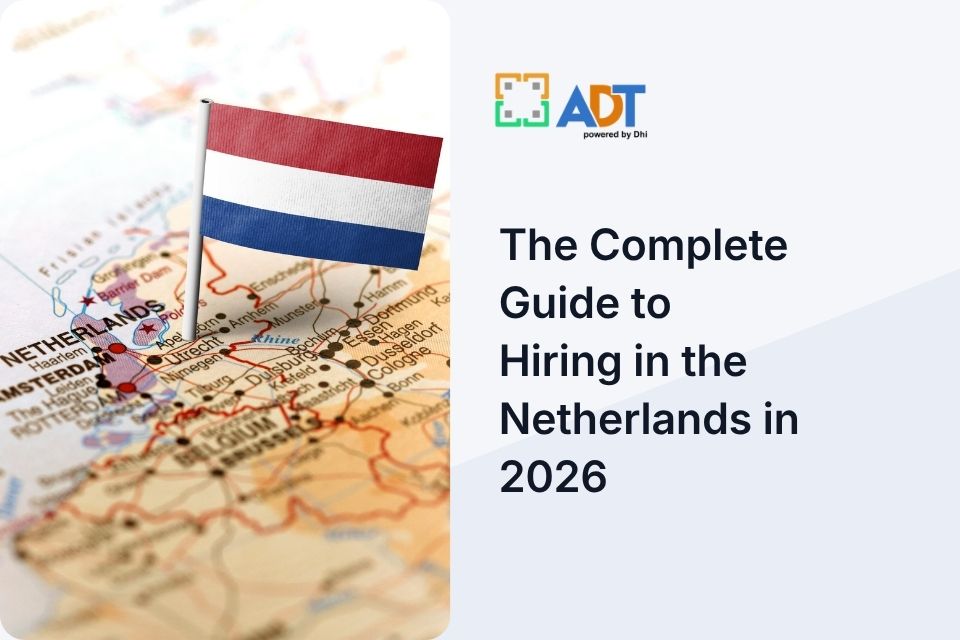

The Complete Guide to Hiring in the Netherlands 2026
Hiring structure, employment law, payroll, visas, and compliance — everything you need to get it right from day one.
Why Getting the Structure Right Matters
Hiring in the Netherlands is straightforward in principle. In practice, it is highly structured — and the consequences of getting it wrong don't always show up immediately.
They surface during audits. At termination. When you're scaling from two employees to twenty and realize your contracts don't hold up.
Dutch employment law sits firmly on the employee's side. Tax, payroll, and social security obligations are non-negotiable. And the model you choose — entity, EOR, or contractor — determines your risk exposure from day one.
Most companies struggle not with finding talent in the Netherlands. They struggle with getting the employment structure right before their first hire.
|
The three realities of hiring in the Netherlands:
1. Dutch employment law is highly protective of employees. 2. Payroll, tax, and social security obligations are strict and non-negotiable. 3. Your hiring model — Local entity, EOR, or contractor — determines your risk exposure. |
Three Ways to Hire in the Netherlands
You do not need a Dutch legal entity to employ someone in the Netherlands. Here are the three primary options — and when each makes sense.
1. Employer of Record (EOR)
An EOR acts as the legal employer on your behalf. You direct the work. The EOR manages employment compliance, payroll, and statutory obligations.
-
No entity required
-
Hire in 1–3 weeks
-
Compliance managed externally
-
Well-suited for your first 1–5 hires or exploratory market entry
-
Can sponsor work visas on your behalf if you lack IND Recognized Sponsor status
2. Setting Up a Dutch Entity (BV or Branch)
If you're committing to the Dutch market long-term, registering a BV (Besloten Vennootschap) gives you full operational control. Incorporation typically takes 2–4 months, inclusive of banking setup.
Ongoing obligations once registered include payroll administration, corporate tax filings, Dutch labour law compliance, and annual financial reporting. This is the right structure when you're hiring 10+ employees and operating for the long term.
3. Contracting via ZZP (Zelfstandige Zonder Personeel ) independent contractor/freelancer
In theory, you can engage Dutch freelancers (ZZP) for project-based work. In practice, 2026 is not the year to rely on this model without careful assessment.
-
Enforcement under the Wet DBA has resumed — the Belastingdienst now actively audits based on the actual working relationship, not just contract wording
-
The proposed VBAR legislation (expected in 2026/2027) may introduce a legal presumption of employment based on income thresholds
-
Misclassification is treated retroactively — triggering wage tax reassessments, social security contributions, penalties, and potential employee claims
Dutch authorities assess the substance of the relationship over the form of the contract, focusing on factors such as:
-
Degree of control and supervision
-
Whether the work is embedded in the organisation
-
Economic dependency on a single client
-
Requirement for personal service (no genuine substitution)
Use contractors only where the work is genuinely project-based, the individual operates independently, and they have multiple clients. If the relationship resembles employment, it will be treated as employment.
Decision at a Glance
|
Best For |
Timeline |
|
|
Employer of Record (EOR) |
1–5 hires, quick market entry, zero entity overhead |
1–3 weeks |
|
Dutch Entity (BV) |
10+ hires, long-term commitment, full operational control |
2–4 months |
|
Contractor (ZZP) |
Genuine project-based, multi-client, independent work |
Immediate — but scrutinised in 2026 |
Employment Contracts
Dutch law does not strictly require written contracts. In practice, you always use one — and you always get the terms right before signing.
Fixed-Term vs Permanent Contracts
Dutch law limits the use of fixed-term contracts to prevent indefinite use of temporary arrangements. The rules are cumulative:
-
Maximum of 3 consecutive fixed-term contracts, OR a total duration of 36 months — whichever comes first
-
Exceed either limit and the contract automatically converts to permanent employment
-
You are not required to provide legal grounds for non-renewal of a fixed-term contract — but you must give advance notice, typically one month
Repeated short-term contracts used to avoid permanence will be scrutinised. Don't structure contracts as a workaround.
Probation Periods
|
Contract Duration |
Maximum Probation |
|
Under 6 months |
Not permitted |
|
6 months to 2 years |
1 month |
|
2 years or permanent |
2 months |
Note: Any probation period exceeding these limits is legally void. Many employers default to maximum probation without checking contract duration — this is a common compliance gap.
Notice Periods
|
Employer Notice Period |
Duration |
|
0–5 years tenure |
1 month |
|
5–10 years tenure |
2 months |
|
10–15 years tenure |
3 months |
|
15+ years tenure |
4 months |
|
Employee notice period |
Typically 1 month (extendable with legal constraints) |
In most cases, the standard notice period for an employee is one month.
However, both the employer and employee can mutually agree in writing to a shorter or longer notice period. This can extend up to a maximum of 6 months.
If a longer notice period is agreed, there is an important rule:
the employer’s notice period must be at least twice the notice period of the employee.
Both employers and employees are protected under dismissal laws, which define how and when termination can take place.
One key requirement is that notice must typically be given effectively from the end of a calendar month.
In some cases, this can be adjusted. A different notice date may be allowed if it is explicitly agreed in the employment contract or defined under a collective labour agreement.
There are also exceptions where standard notice periods do not apply:
-
During a trial period, either party may terminate immediately
-
In cases of serious misconduct (such as theft), termination can happen with immediate effect and without notice
Mandatory Contract Elements
Every Dutch employment contract must include, at minimum:
-
Salary and payment schedule
-
Working hours
-
Leave entitlement
-
Job description
-
Applicable notice period
-
Reference to any applicable Collective Labour Agreement (CAO)
CAO applicability is often missed by foreign employers. If a sector CAO applies, its terms — on pay, leave, working conditions — are binding and may override what your contract says.
Payroll, Tax, and Employer Costs
A €60,000 salary is not a €60,000 cost. Dutch employer obligations add significantly to the bill — and this is frequently underestimated by companies entering the market.
Employer Cost Breakdown
|
Cost Component |
Amount (Example: €60K Salary) |
|
Base salary |
€60,000 |
|
Mandatory holiday allowance (8% of annual salary) |
€4,800 |
|
Employer social security contributions |
~ 20–22% of salary |
|
Sector pension (if applicable under CAO) |
Varies by sector |
|
Total employer cost (estimated) |
€75,000–€85,000/year |
Note: Social security rates and tax bands are updated annually. Always verify current figures with your payroll provider before budgeting.
Key Payroll Components
-
Loonbelasting (wage tax): withheld at source monthly by the employer
-
Holiday allowance (vakantiegeld): mandatory 8% of annual gross salary, typically paid in May
-
Social security contributions: split between employer and employee — the employer portion is a significant cost line
-
Pension contributions: in many sectors, participation is mandatory under a sector CAO. This is frequently overlooked by international employers and can result in retroactive obligations
Working Hours, Leave, and Sick Pay
Working Hours
-
Standard: 36–40 hours per week
-
Legal maximum: 60 hours per week (averaged over a reference period)
-
Collective agreements may set lower maximums in specific sectors
Annual Leave
-
Statutory minimum: 4x contracted weekly hours (20 days for a full-time employee)
-
Market standard: 25 days or more — most competitive employers offer this
-
In addition to annual leave days, employees are entitled to a holiday allowance, which, in general, equals 8.33% of the annual salary, insofar as the annual salary does not exceed three times the annual equivalent of the minimum wage.
Sick Leave — The Part Most Employers Get Wrong
Sick leave in the Netherlands is one of the most significant financial and operational risks for employers. The statutory obligation is substantial:
-
Employers are obliged to continue to pay the salaries of sick employees for the first two years of illness.
-
The employer is obliged to pay 70% of the employee’s salary, but during the first year of sickness payment cannot be less than the minimum wage. For the second year, the minimum wage limit does not apply.
-
There are active reintegration obligations throughout — the employer must facilitate return-to-work
-
Failure to comply with reintegration obligations can extend the obligation beyond 2 years
|
Practical note on sick leave: Most Dutch employers insure this risk via a private income protection policy. If you're hiring without local HR expertise, this is one of the first things to arrange — before you have a sick employee, not after. |
Termination
Termination in the Netherlands is not discretionary. It requires a defined process, legitimate grounds, and — in employer-initiated cases — a statutory severance payment.
Three Legitimate Termination Routes
-
Mutual agreement (vaststellingsovereenkomst): Both parties agree to terminate the employment via a settlement agreement. This is the most commonly used route in practice. The employee has a statutory cooling-off period to withdraw consent.
-
UWV approval: Required for dismissals based on:
-
Redundancy (economic reasons
-
Long-term incapacity (after 104 weeks of illness)
-
The UWV (Employee Insurance Agency) assesses whether a reasonable ground
-
exists and whether redeployment is possible before granting permission.
Court dissolution (kantonrechter) - Used for all other grounds, such as:
-
Underperformance or unsuitability (not due to illness)
-
Misconduct (non-urgent)
-
Disrupted working relationship
-
Cumulation of multiple grounds
The court may approve or reject the termination request.
Transition Payment (Severance)
The statutory transition payment (transitievergoeding) is due in most employer-initiated terminations under the Dutch Civil Code (Burgerlijk Wetboek) Book 7:
• Calculation: 1/3 of the monthly salary per year of service (pro rata)
• Eligibility: Applies from the first day of employment
• Payment timing: Must be paid within one month after the end of employment
Protected Categories
Termination is heavily restricted — and in some cases prohibited — during:
-
Sick leave (the first 2 years of illness)
-
Pregnancy and maternity leave
-
Certain other protected circumstances (e.g. works council membership)
Note: Exceptions exist but are limited and closely scrutinised. Attempting to terminate during a protected period without proper process exposes the company to reinstatement orders and additional compensation claims.
Hiring International Talent
IND Recognised Sponsor Status
To hire non-EU nationals I n the Netherlands, your organisation must hold IND (Immigration and Naturalisation Service) Recognised Sponsor status. Without it, you cannot directly sponsor work permits.
If you don't have a Dutch entity — and therefore cannot hold IND status directly — an EOR can sponsor visa applications on your behalf. This is one of the most practical use cases for EOR in an international hiring context.
Highly Skilled Migrant Visa — 2026 Salary Thresholds
The Dutch Highly Skilled Migrant (Kennismigrant) visa is income-based. Thresholds are updated annually by the IND:
-
Aged 30 or above: approximately €5,942/month gross
-
Under 30: approximately €4,357/month gross
Note: These thresholds are indicative for 2026. Always confirm current figures directly with the IND or your immigration partner before making an offer.
The 30% Ruling
The 30% ruling is a tax benefit for internationally recruited employees, allowing 30% of gross salary to be paid tax-free as a cost reimbursement. Key points for 2026:
-
Duration: 5 years from the start of employment in the Netherlands
-
Currently under reform — a reduction to 27% is planned from 2027
-
Not all employees qualify: specific distance and expertise requirements apply
-
Significant retention and compensation planning implications for international hires
Contractor vs Employee in 2026
The risk of misclassification has increased materially since enforcement under Wet DBA resumed. The Dutch tax authority (Belastingdienst) now assesses the actual working relationship — not the label on the contract.
What Authorities Look At
-
Does the worker operate under instruction and oversight?
-
Is the work structural rather than project-based?
-
Does the individual work predominantly or exclusively for one client?
-
Are there any indicators of economic dependency?
If the answer to most of these is yes, the relationship will likely be reclassified as employment — retroactively.
What's Coming: VBAR
The proposed VBAR legislation (Verduidelijking Beoordeling Arbeidsrelaties en Rechtsvermoeden) is expected to introduce a statutory employment presumption based on income level. Companies currently relying on contractors at levels typical of employment will face the most exposure.
The practical shift we're already seeing: companies are moving away from contractor arrangements towards employment contracts or EOR — particularly for roles that are ongoing, core, or involve significant oversight.
EOR vs Dutch Entity: What to Choose
|
Factor |
EOR |
Dutch Entity |
|
Setup time |
1–3 weeks |
2–4 months |
|
Upfront cost |
Low (no incorporation fees) |
€3,000–€10,000+ |
|
Ongoing compliance |
Managed by EOR |
Fully internal |
|
Flexibility |
High — scale up or exit easily |
Low — entity obligations remain |
|
Visa sponsorship |
EOR can sponsor on your behalf |
Requires IND recognition |
|
Best for |
Early-stage or exploratory hires |
Long-term, scale operations |
When EOR Is the Right Call
-
You need to hire in weeks, not months
-
You don't have a Dutch legal entity
-
You want compliance managed externally while you focus on operations
-
You need to sponsor an international hire without IND status
-
You're testing the market before committing to full entity setup
One important note: using an EOR transfers employment obligations — but not operational responsibility. You remain accountable for the day-to-day management of your employees and for ensuring working practices align with Dutch law.
Get in touch with us:
Netherlands (HQ) : +31 97010207974
UK (HQ) : +44 7401131349
Belgium : +32 460254634
Follow us on:
LinkedIn : https://www.linkedin.com/company/dhi-adt/



_1790144161.jpg)







 experts@adtsolution.com


 Queens towers, Delflandlaan 1, 1062 EA Amsterdam, The Netherlands



Comments (0)
No comments yet. Be the first to comment!