 AUG (Authorized User Group) Certified
 IND-recognised sponsor
 Nasscom Certified
 SNA Certified
Author : Shrinivas Sadalawar
Head of Product, ADT
Shrinivas leads product at ADT, building platforms that make global workforce operations — payroll, EOR, and compliance, simple and scalable. With a strong background in product strategy and enterprise platform development, he focuses on solving real problems for businesses growing across borders.
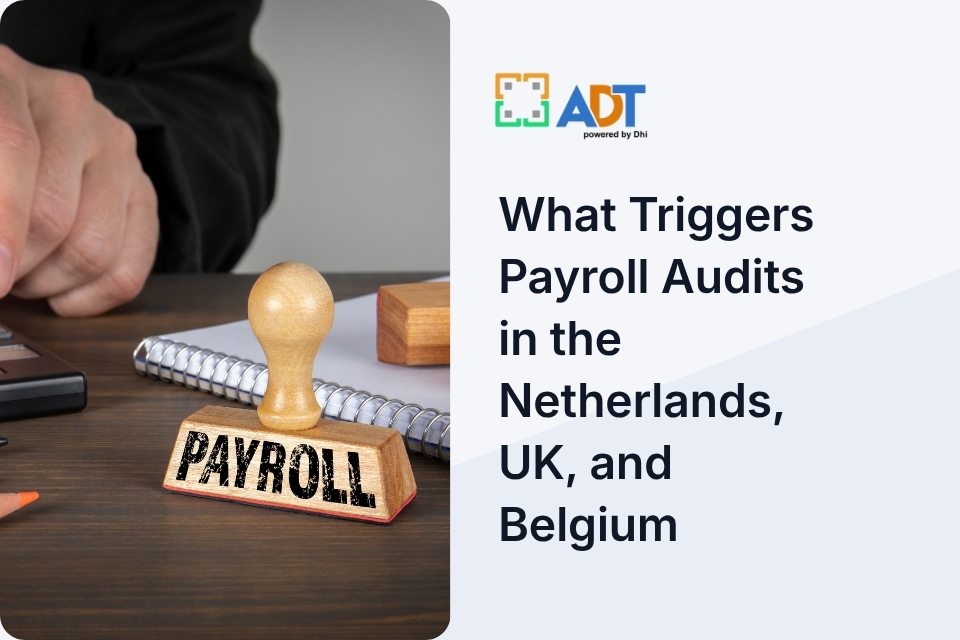
What Triggers Payroll Audits in the Netherlands, UK, and Belgium
Expanding into Europe introduces a structured payroll environment.
Most companies understand this at a high level.
What is less visible is how payroll compliance in Europe is actually enforced.
Audits are not random.
They are triggered.
And in most cases, the triggers are not large violations.
They are small inconsistencies that accumulate across payroll, contracts, and reporting.
Understanding these triggers is critical for companies managing:
-
multi-country teams
-
cross-border employment structures
Why Payroll Audits Happen
Across European markets, payroll audits are typically initiated when authorities detect:
-
inconsistencies in filings
-
misalignment between payroll and employment structure
-
reporting gaps across tax or social security systems
These are often categorized as audit red flags in payroll, and they form the basis of most reviews.
The key point is this:
Audits are rarely triggered by a single event.
They are triggered by patterns.
Common Payroll Audit Triggers Across Europe
1. Worker Misclassification
One of the most frequent triggers is employee misclassification risk.
This includes:
-
contractors operating like employees
-
incorrect employment status declarations
-
inconsistent tax treatment
Across Europe, this can lead to:
-
worker misclassification payroll penalties
-
retroactive tax liabilities
-
social security corrections
In the Netherlands, this is closely linked to the DBA Act contractor misclassification framework.
In the UK, it connects to IR35 audit triggers.
2. Late or Inaccurate Payroll Filings
Another major trigger is late payroll filing penalties in Europe.
Authorities expect:
-
timely submission
-
accurate reporting
-
consistency across filings
Even minor delays or discrepancies can lead to:
-
penalties
-
additional scrutiny
-
follow-up audits
This is particularly relevant in:
-
UK PAYE compliance systems
-
Netherlands wage tax reporting
-
Belgium payroll declarations
3. Payroll Reporting Inconsistencies
Payroll does not operate in isolation.
It connects with:
-
employment contracts
-
tax filings
-
social security contributions
When inconsistencies appear across these systems, they create payroll reporting requirement mismatches.
For example:
-
salary declared vs salary paid
-
benefits classified incorrectly
-
contributions calculated differently across filings
These mismatches are often picked up during automated checks.
4. Social Security Contribution Errors
Across Europe, social security contributions are tightly regulated.
Errors can occur due to:
-
incorrect classification
-
wrong contribution rates
-
incomplete declarations
These errors are particularly sensitive because they affect:
-
employee entitlements
-
government contributions
-
compliance records
Country-Specific Audit Triggers
While patterns are similar, each country has its own enforcement focus.
Netherlands: Belastingdienst Payroll Audit Triggers
The Dutch tax authority (Belastingdienst) focuses on:
-
Netherlands wage tax compliance
-
contractor classification under the DBA Act
-
correct handling of benefits and allowances
Common triggers:
-
misclassification of contractors
-
incorrect wage tax filings
-
inconsistent payroll declarations
United Kingdom: HMRC Payroll Compliance Checks
In the UK, audits are often initiated through:
-
HMRC payroll compliance checks
-
PAYE reporting discrepancies
-
IR35 classification reviews
Common triggers include:
-
incorrect PAYE submissions
-
failure to apply IR35 correctly
-
mismatched employee records
Belgium: NSSO Payroll Inspections
Belgium has one of the most structured payroll systems.
The NSSO payroll inspection Belgium process focuses on:
-
social security contributions
-
employment classification
-
payroll declarations
A key trigger is:
-
DmfA declaration errors in Belgium
These errors can include:
-
incorrect employee data
-
missing contributions
-
reporting inconsistencies
How Payroll Errors Turn Into Penalties
Payroll issues rarely appear immediately.
Instead, they surface during:
-
audits
-
reconciliations
-
inspections
At that point, companies may face:
-
payroll errors and penalties
-
retroactive tax corrections
-
compliance adjustments
The cost is not only financial.
It also includes:
-
operational time
-
internal disruption
-
regulatory attention
How Companies Can Reduce Audit Risk
The goal is not to eliminate audits entirely.
It is to ensure that when audits happen, the system holds.
Strong teams focus on:
1. Alignment Across Systems
Ensure consistency between:
-
payroll
-
contracts
-
tax filings
2. Classification Clarity
Review:
-
contractor vs employee status
-
employment structures
-
reporting alignment
3. Process Stability
Build payroll processes that:
-
repeat reliably
-
do not depend on manual intervention
-
scale with team growth
4. Periodic Reviews
Many companies run:
-
internal payroll audits
-
compliance checks
before authorities do.
Final Thought
Payroll compliance in Europe is not inherently difficult.
But it is structured.
And structure requires consistency.
Most audit triggers are not unexpected.
They are simply unnoticed earlier.
If your team is operating across the Netherlands, UK, or Belgium,
it may be useful to review:
-
payroll reporting accuracy
-
classification structure
-
compliance alignment
We work with companies to identify:
-
audit risks
-
structural gaps
-
payroll inconsistencies
before they surface.
You can reach out to the ADT team for a structured payroll review.
Get in touch with us:
Netherlands (HQ) : +31 97010207974
UK (HQ) : +44 7401131349
Belgium : +32 460254634
Follow us on:
LinkedIn : https://www.linkedin.com/company/dhi-adt/
Frequently Asked Questions
What triggers a payroll audit in the Netherlands?
Payroll audits in the Netherlands are typically triggered by inconsistencies in wage tax filings, contractor misclassification under the DBA Act, and reporting discrepancies identified by the Belastingdienst.
How does HMRC select employers for payroll audits in the UK?
HMRC uses data-driven checks to identify discrepancies in PAYE reporting, IR35 classification issues, and inconsistencies between payroll submissions and tax records.
What are the key payroll inspection red flags in Belgium?
Common red flags include DmfA declaration errors, incorrect social security contributions, and inconsistencies in employee classification reported to the NSSO.
How can companies avoid payroll audits across Europe?
Companies can reduce audit risk by ensuring alignment between payroll, contracts, and tax filings, maintaining accurate reporting, and conducting periodic internal compliance reviews.
How does the EU Pay Transparency Directive impact payroll compliance?
The directive increases reporting requirements around compensation structures, making payroll transparency and consistency more critical across EU markets.

 Blue Card, Anmeldung & Netherlands Comparison_1788936018.jpg)







 experts@adtsolution.com


 Queens towers, Delflandlaan 1, 1062 EA Amsterdam, The Netherlands



Comments (0)
No comments yet. Be the first to comment!