 AUG (Authorized User Group) Certified
 Nasscom Certified
 SNA Certified
Author : Varun Chauhan
Global Strategy & Growth Manager, ADT
Varun leads global strategy, partnerships and client engagements at ADT, working closely with HR leaders, CFOs, and founders on EOR, payroll, and international hiring strategy. He focuses on helping organizations make the right decisions as they expand across markets.
In 2026, global hiring has become significantly more accessible.
Companies can:
-
hire across countries quickly
-
manage distributed teams with relative ease
But while hiring has become simpler, the underlying decision has become more complex.
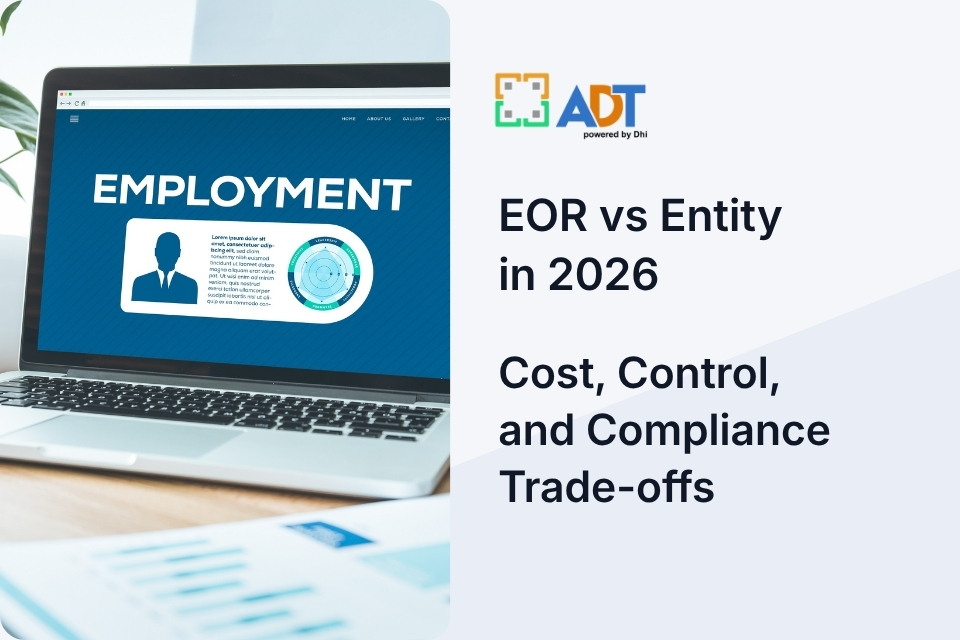
The question is no longer, “should we use an EOR or set up an entity?” It is what structure best supports our growth?”
The Shift in 2026: From Hiring to Structure
Historically, EOR was seen as a shortcut.
Today, it is part of a broader global hiring strategy in 2026.
At the same time, entity setup is no longer viewed as a default.
Instead, companies are evaluating:
-
cost
-
control
-
compliance together.
Employer of Record Cost Breakdown (2026)
Understanding employer of record cost breakdown in 2026 is essential.
EOR pricing typically includes:
-
per-employee service fee
-
payroll processing
-
employment liability
While this provides simplicity, companies are increasingly analyzing:
-
EOR pricing vs subsidiary cost comparison
-
long-term cost scalability
Legal Entity Setup Cost Internationally
Setting up an entity involves:
-
registration
-
legal structuring
-
accounting setup
-
payroll infrastructure
The legal entity setup cost internationally varies by country, but includes both:
-
initial setup costs
-
ongoing compliance costs
These costs are largely fixed.
Which means they become more efficient as headcount increases.
Control: The Most Underestimated Factor
One of the most overlooked aspects of EOR is control.
With EOR:
-
employment is managed externally
-
policies are influenced by provider frameworks
This can lead to a loss of control with employer of record, particularly in areas such as:
-
compensation design
-
benefits structure
-
employment flexibility
With an entity:
-
control is fully internal
-
customization becomes easier
Compliance: Ownership vs Delegation
Compliance is often misunderstood in EOR structures.
While EOR providers manage compliance, companies must still consider:
-
reporting accuracy
-
audit readiness
-
local obligations
At scale, global expansion compliance risks in 2026 become more visible.
With an entity, compliance responsibility shifts fully in-house.
This includes:
-
foreign entity compliance obligations
-
payroll tax filings
-
employment law adherence
Hidden Costs of EOR
EOR pricing is transparent.
But companies often discover employer of record hidden costs over time, such as:
-
scaling inefficiencies
-
limitations in structure flexibility
-
dependency on external systems
These are not immediate issues.
But they influence long-term decision-making.
Entity Setup Timeline by Country
Another factor in the decision is time.
The entity setup timeline by country typically ranges from:
-
4–12 weeks depending on jurisdiction
This delay is why many companies begin with EOR.
But as hiring stabilizes, they begin planning entity setup in advance.
EOR Exit Strategy: Switching to Entity
One of the most critical considerations in 2026 is having a clear EOR exit strategy switching to entity.
This includes:
-
timing the transition
-
managing employee transfers
-
maintaining compliance continuity
Companies that plan this early experience fewer disruptions.
EOR vs Legal Entity in 2026: The Real Trade-off
The decision is not binary.
It is contextual.
EOR works best when:
-
hiring is early-stage
-
speed is critical
-
flexibility is required
Entity works best when:
-
hiring is stable
-
scale is confirmed
-
control and cost efficiency matter
Final Thought
In 2026, global hiring is no longer constrained by infrastructure.
But structure still determines how well that hiring scales.
EOR and entity are not competing models.
They are sequential decisions in a company’s growth journey.
If your team is evaluating:
-
EOR vs entity decisions
-
cost vs control trade-offs
-
global workforce structure
we can help you assess:
-
current setup
-
future hiring plans
-
transition timing
You can reach out to the ADT team for a structured discussion.
Get in touch with us:
Netherlands (HQ) : +31 97010207974
UK (HQ) : +44 7401131349
Belgium : +32 460254634
Follow us on:
LinkedIn : https://www.linkedin.com/company/dhi-adt/

_1790144161.jpg)






 experts@adtsolution.com


 Queens towers, Delflandlaan 1, 1062 EA Amsterdam, The Netherlands



Comments (0)
No comments yet. Be the first to comment!