 AUG (Authorized User Group) Certified
 IND-recognised sponsor
 Nasscom Certified
 SNA Certified
Author : Shrinivas Sadalawar
Head of Product, ADT
Shrinivas leads product at ADT, building platforms that make global workforce operations — payroll, EOR, and compliance, simple and scalable. With a strong background in product strategy and enterprise platform development, he focuses on solving real problems for businesses growing across borders.
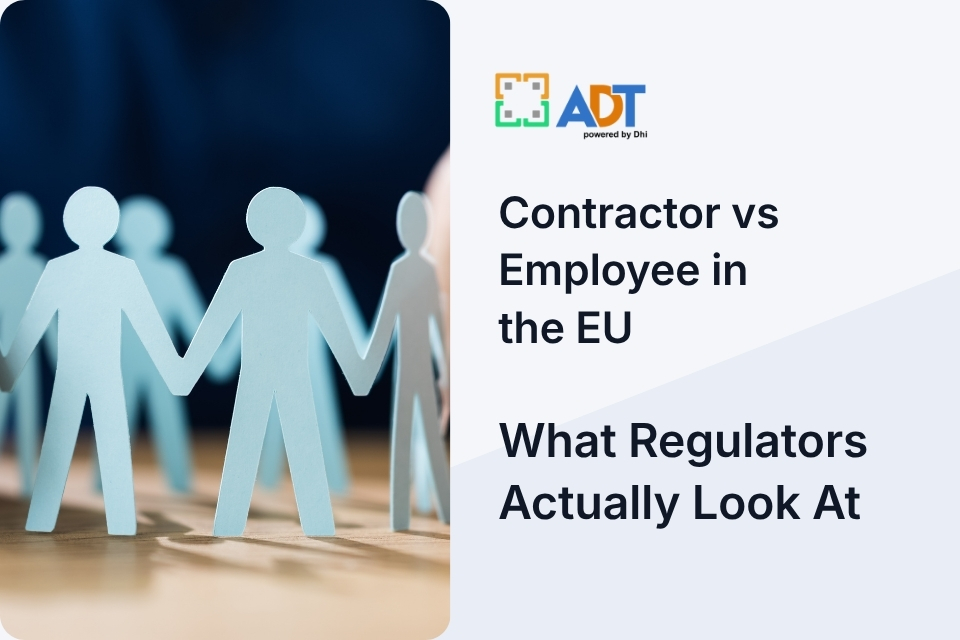
Contractor vs Employee in the EU: What Regulators Actually Look At
Hiring in Europe often begins with a practical decision:
Should we hire contractors or employees?
At first, the contractor model appears simpler.
-
faster onboarding
-
lower administrative burden
-
no immediate entity requirement
But across the EU, this decision is not based on preference.
It is based on employment status criteria under EU labor law compliance.
And regulators do not rely on labels.
They look at the reality of the working relationship.
Why Classification Matters
The distinction between contractor and employee affects:
-
tax obligations
-
social security contributions
-
employment rights
Misclassification can lead to:
-
financial penalties
-
compliance adjustments
-
legal exposure
This is why worker classification compliance in the EU is a core part of payroll and employment strategy.
The Core Principle: Substance Over Contract
Across Europe, regulators apply a consistent principle:
The contract does not define the relationship.
The working reality does.
Even if someone is labeled as an independent contractor, authorities assess:
-
how they work
-
how they are managed
-
how they are integrated
Key Factors Regulators Evaluate
1. Degree of Control
If the company:
-
defines working hours
-
manages daily activities
-
controls how work is performed
the relationship may resemble employment.
2. Integration Into the Organization
A contractor is expected to operate independently.
If the individual:
-
is part of internal teams
-
participates in company workflows
-
uses company systems
This may indicate employee status.
3. Economic Dependence
If a contractor:
-
works primarily for one company
-
has limited independent clients
This creates dependent contractor conditions in Europe, increasing classification risk.
4. Tools and Infrastructure
Employees typically rely on:
-
company-provided tools
-
internal systems
Contractors usually operate independently.
This distinction is part of employment status criteria in the EU.
Tax and Social Security Implications
Classification directly affects:
-
tax implications contractor vs employee Europe
-
social security obligations in the EU
If misclassification occurs, companies may need to:
-
pay retroactive contributions
-
adjust payroll filings
-
address compliance gaps
Gig Economy and Evolving Classification Rules
The rise of gig work has led to:
-
stricter classification frameworks
-
more defined gig worker classification EU rules
-
increased regulatory enforcement
This means classification decisions are now more structured than before.
Contractor vs Employee: When to Choose What
Contractors may work when:
-
the role is project-based
-
the individual operates independently
-
multiple clients are involved
Employees are more appropriate when:
-
the role is ongoing
-
the individual is integrated into the team
-
control and reporting structures exist
Can You Hire Employees Without an Entity?
Yes.
Companies can use an Employer of Record (EOR)
This allows, compliant hiring, proper payroll handling, and adherence to local labor laws
This is often the alternative when contractor classification becomes risky.
When EOR Becomes the Better Option
Companies typically move to EOR when:
-
contractor roles begin resembling employment
-
compliance risk increases
-
long-term hiring becomes clear
This ensures:
-
payroll compliance for contractors in the EU transitions correctly
-
employment structure aligns with regulatory expectations
Final Thought
Contractor vs employee classification in the EU is not a legal technicality.
It is an operational decision with long-term consequences.
The goal is not to avoid one model.
It is to ensure the model reflects reality.
If your team is hiring across Europe and evaluating:
-
contractor vs employee structures
-
classification risks
-
compliance implications
We can help review your setup and identify potential risks early.
You can reach out to the ADT team for a structured assessment.
Get in touch with us:
Netherlands (HQ) : +31 97010207974
UK (HQ) : +44 7401131349
Belgium : +32 460254634
Follow us on:
LinkedIn : https://www.linkedin.com/company/dhi-adt/
Frequently Asked Questions
Should I hire a contractor or employee when expanding into the EU?
It depends on the nature of the role. If the individual operates independently with multiple clients, a contractor model may work. If the role is integrated and ongoing, employment is usually more appropriate.
Can I hire employees in EU countries without setting up a local entity?
Yes. Companies can use an Employer of Record (EOR) to hire employees compliantly without establishing a local entity.
What are the risks of misclassifying contractors in the EU?
Risks include financial penalties, retroactive tax and social security contributions, and regulatory scrutiny.
When should I choose an EOR instead of hiring contractors in Europe?
EOR is suitable when roles resemble employment, compliance risk increases, or long-term hiring plans are clear.
What factors do EU regulators consider when determining contractor vs employee status?
They assess control, integration, economic dependence, and use of company infrastructure to determine the true nature of the working relationship.


 Blue Card, Anmeldung & Netherlands Comparison_1788936018.jpg)










 experts@adtsolution.com


 Queens towers, Delflandlaan 1, 1062 EA Amsterdam, The Netherlands



Comments (0)
No comments yet. Be the first to comment!