 AUG (Authorized User Group) Certified
 Nasscom Certified
 SNA Certified
Author : Varun Chauhan
Global Strategy & Growth Manager, ADT
Varun leads global strategy, partnerships and client engagements at ADT, working closely with HR leaders, CFOs, and founders on EOR, payroll, and international hiring strategy. He focuses on helping organizations make the right decisions as they expand across markets.
Expanding into Europe often begins with a deceptively simple question
Where should we hire first?
For many companies, the Netherlands, the United Kingdom, and Belgium appear similar at first glance.
All three markets offer:
• strong talent pools
• developed infrastructure
• access to major European business hubs
But from a payroll and employment perspective, the cost structures are not identical.
And the difference is rarely salary.
It is everything around salary.
For companies planning to hire 1–20 employees, understanding these structural differences early can significantly affect both cost planning and operational complexity.
If your team is currently evaluating where to build its first European team, it is worth modeling these differences before hiring begins.
Netherlands: Structured and Transparent
The Netherlands is widely considered one of the most stable employment environments for international companies.
Payroll systems are predictable and regulations are clearly documented.
However, the employment structure includes several elements that companies must plan carefully.
Employers typically account for:
• wage tax administration
• national insurance contributions
• employer social contributions
• holiday allowance (8%)
• sector pension participation (in certain industries)
The holiday allowance is usually well understood.
But pension obligations are often the component companies discover later in the process.
For this reason, many organizations run a quick payroll structure review before their first Dutch hire.
A short check often clarifies whether additional employer obligations will apply.
United Kingdom: Operational Simplicity
Among European markets, the UK is generally one of the most operationally straightforward for international employers.
The payroll structure typically includes:
• PAYE tax reporting
• employer National Insurance contributions
• pension auto-enrollment
While these obligations must be managed correctly, the administrative structure is usually easier for companies unfamiliar with European payroll systems.
Another advantage is familiarity.
Many global finance teams already understand UK payroll structures, which reduces the learning curve during expansion.
For companies hiring smaller teams (1–10 employees), the UK often becomes a practical starting point.
Belgium: Higher Contributions, Strong Worker Protections
Belgium offers access to a highly educated and technically skilled workforce.
But its payroll structure is also one of the most comprehensive in Europe.
Employer social contributions can reach 25–30% of gross salary depending on the situation.
Additional payroll components may include:
• social security contributions
• holiday pay structures
• reporting obligations
• strict worker protection frameworks
None of these make Belgium unattractive.
But they do mean that employment costs must be modeled carefully before hiring begins.
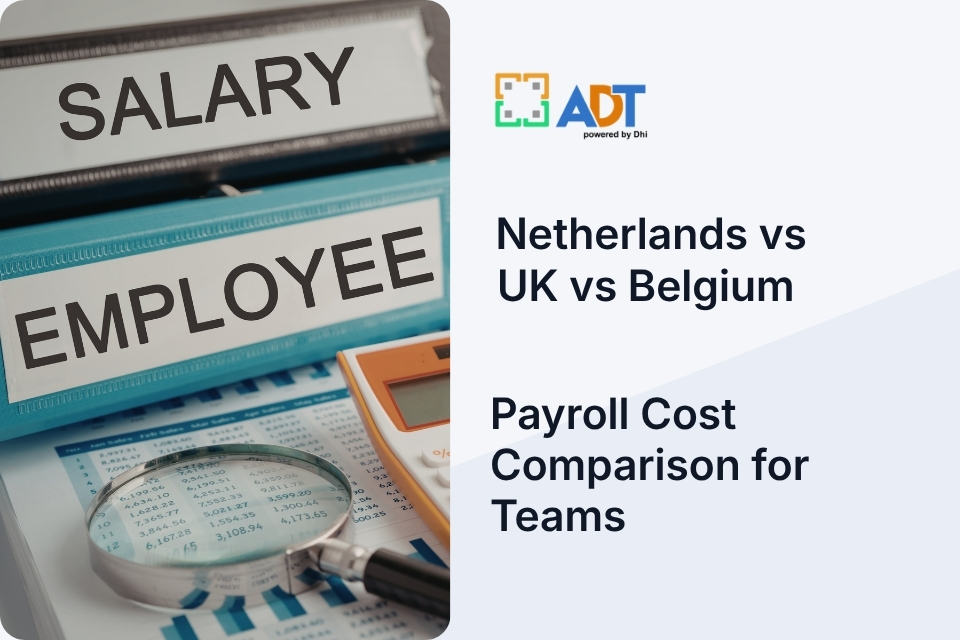
Why Payroll Cost Comparisons Can Be Misleading
One of the most common mistakes companies make is comparing gross salaries alone.
For example:
A €70,000 salary in each country may appear identical.
But once employer contributions, pensions, and payroll obligations are included, the true employment cost can vary significantly.
The real cost of employment usually includes:
• gross salary
• employer social contributions
• pension obligations
• payroll administration costs
• compliance overhead
Understanding the full structure often changes the expansion conversation.
Headcount Changes the Equation
Payroll differences become more visible as teams grow.
For example:
Small teams (1–5 employees) usually prioritize speed and flexibility.
Operational simplicity often matters more than cost differences.
But once teams approach 10–20 employees, companies often begin evaluating
• entity vs EOR structures
• payroll governance models
• long-term cost optimization
Running these numbers early makes expansion decisions significantly easier later.
Final Thought
European expansion decisions usually start with questions about customers and markets.
But operational details eventually determine how smoothly expansion unfolds.
Payroll structure is one of those details.
Understanding how the Netherlands, the UK, and Belgium differ can prevent unexpected complexity later.
If your team is planning to hire across these markets in the coming months, it may be useful to review the structural implications before the first offer goes out.
Workforce Structure Review
If you're comparing hiring across these markets, we can help walk through the cost structure and compliance implications.
In a short consultation we usually review
• payroll cost modeling
• employer contribution differences
• EOR vs entity considerations
• governance implications
Sometimes a 30-minute review provides enough clarity to avoid months of uncertainty.
Get in touch with us:
Netherlands (HQ) : +31 97010207974
UK (HQ) : +44 7401131349
Belgium : +32 460254634
Follow us on:
LinkedIn : https://www.linkedin.com/company/dhi-adt/



_1790144161.jpg)








 experts@adtsolution.com


 Queens towers, Delflandlaan 1, 1062 EA Amsterdam, The Netherlands



Comments (0)
No comments yet. Be the first to comment!