 AUG (Authorized User Group) Certified
 IND-recognised sponsor
 Nasscom Certified
 SNA Certified

EOR vs Entity Setup in Europe: A Decision Framework
The decision behind the decision
Most companies don't actually have a 'should we set up an entity' question. They have a 'should we hire in Europe right now' question — and entity setup is the answer they think they have to give.
That framing costs companies serious time and money. An EU entity setup typically takes three to six months, costs €15,000–€40,000 in setup fees alone, and commits the company to ongoing accounting, legal, and HR overhead in that country — whether you have one employee there or fifty.
The right question is: do you need permanent presence in this market, or do you need someone employed there? Those are different problems with different answers.
What an entity actually gives you
Setting up a legal entity in an EU country — typically a BV (Netherlands), GmbH (Germany), SARL (France), or equivalent — gives you:
• Direct legal presence and the ability to sign contracts locally
• Direct employment of staff under your own brand and HR policies
• The ability to bill local customers in local currency through a local invoice
• Access to local tax incentives, R&D credits, and government schemes
• Long-term cost efficiency at scale (typically 20+ employees in one country)
What an EOR (Employer of Record) actually gives you
An EOR is a separate legal entity that employs people on your behalf. The EOR is the legal employer; your company is the operational employer. Practically, this means:
• You can hire employees in countries where you have no entity — typically within two to four weeks
• The EOR handles payroll, taxes, social security, statutory benefits, employment contracts, and compliance
• The employee works for you day-to-day — reports into your team, follows your processes, uses your tools
• You pay the EOR a monthly fee per employee, typically €250–€600 in Western Europe
• You retain operational control without taking on legal employer liability
The decision framework
Five questions determine the right path. Walk through them in order.
1. How many employees in this country in the next 12 months?
Fewer than 5: EOR almost always makes more sense. Setup cost is unrecoverable at this scale.
5–15: Comparable cost on a 3-year horizon. Decision depends on questions 2–5.
15+: Entity typically becomes more cost-effective, especially if you're growing further. But other factors can still tip it the other way.
2. How fast do you need to hire?
If the first employee needs to start in under 60 days: EOR. Entity setup cannot move that fast.
If you can wait 3–6 months: entity is feasible.
3. Is this a permanent market for you, or are you testing?
Testing a market for product-market fit, sales viability, or talent quality: EOR. The optionality is worth the per-head cost.
Committed long-term presence: entity may make sense, especially combined with local sales operations.
4. Do you need to sign commercial contracts locally?
If you need to bill customers from a local entity (regulated industries, government contracts, certain B2B requirements): entity is mandatory.
If your hires are operational (engineering, support, marketing) and contracts are signed from HQ: EOR works.
5. What is the talent's appetite for risk?
Senior hires especially in Western Europe sometimes prefer being employed by the company directly. Some see EOR employment as second-class. This is usually overcome through clear communication, but it is a factor.
Common scenarios
Scenario 1 — The US scaleup testing Europe
A US Series B company wants to hire its first three engineers in Amsterdam to test European talent quality and time-zone advantages. They are not yet sure if they will commit to Europe long-term.
Right path: EOR. The decision to commit to entity should wait until headcount and strategic intent are clearer. Setting up a BV now would burn €25K+ before the company has validated the market.
Scenario 2 — The post-Series-C company building a German hub
A SaaS company has committed to Germany as its EU base. They expect 20 employees by year-end and 50 within 18 months. They want unified employer branding and German tax incentives.
Right path: entity, eventually. But hire the first 5–10 through an EOR while the GmbH is being set up. This lets the team start operating now, not in six months.
Scenario 3 — The Indian IT services company with a single client
An Indian IT services company has won a contract requiring three engineers onsite in the Netherlands for 18 months. After the contract, the requirement may or may not continue.
Right path: EOR. The duration is too short to amortise entity setup costs, and the future uncertainty makes the optionality of an EOR valuable.
Scenario 4 — The regulated business
A fintech needs to operate in France with local employees. French financial regulation requires the operating entity to be locally licensed.
Right path: entity (the EOR question doesn't really apply — regulation forces the answer).
The hybrid path nobody talks about
The most cost-effective path for many companies is sequential, not binary. Start with an EOR. Operate for 12–18 months. Then, if the market justifies it, transition to a wholly-owned entity — and migrate the EOR employees across.
This approach gets you to market in weeks, lets you validate before committing, and means the entity decision is made with real data — your actual hiring volume, your actual cost structure, your actual revenue from the region.
The transition itself is structured: the employees move from being employed by the EOR to being employed by your new local entity, usually with continuity of service and no break in employment from their perspective.
Where it gets complicated
• Permanent establishment risk — even using an EOR, certain activities (signing contracts, holding inventory, sales authority) can create tax presence for your company. The threshold varies by country.
• Sector regulation — financial services, healthcare, defence, and certain professional services often require local entities by law, regardless of headcount.
• IP and equity — if employees need to be granted equity, or if they are creating IP, the structure of the EOR relationship matters for legal cleanness.
• Country-specific quirks — Belgium's TEA model restricts standard EOR practice; France has strict labour code requirements; Germany has works council obligations at scale.
These are the cases where a generic 'EOR vs entity' calculation doesn't give you the right answer.
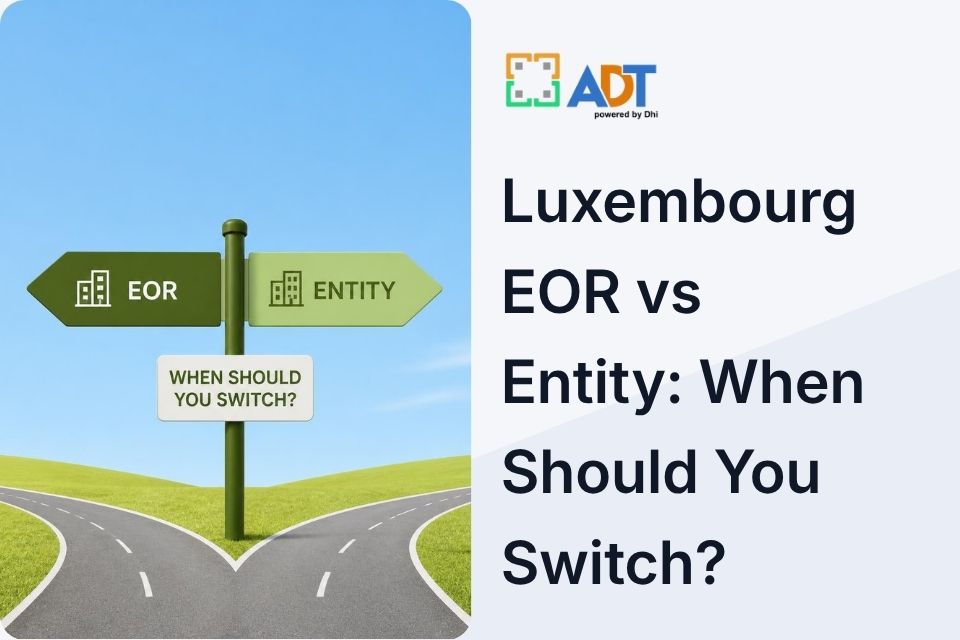
There is no one-size-fits-all answer to EOR vs entity setup.
The right choice depends on your hiring plans, growth timeline, operational needs, and long-term strategy. The companies that scale most effectively across Europe are usually the ones that choose the structure that fits their current stage while keeping future expansion in mind.
In many cases, the question is not whether to use an EOR or establish an entity. It is when each option makes the most sense. The strongest expansion strategies balance speed, compliance, flexibility, and scalability as the business grows.
Get in touch with us:
Netherlands (HQ) : +31 97010207974
UK (HQ) : +44 7401131349
Belgium : +32 460254634
Follow us on:
LinkedIn : https://www.linkedin.com/company/dhi-adt/
 Blue Card, Anmeldung & Netherlands Comparison_1788936018.jpg)






 experts@adtsolution.com


 Queens towers, Delflandlaan 1, 1062 EA Amsterdam, The Netherlands



Comments (0)
No comments yet. Be the first to comment!