 AUG (Authorized User Group) Certified
 Nasscom Certified
 SNA Certified
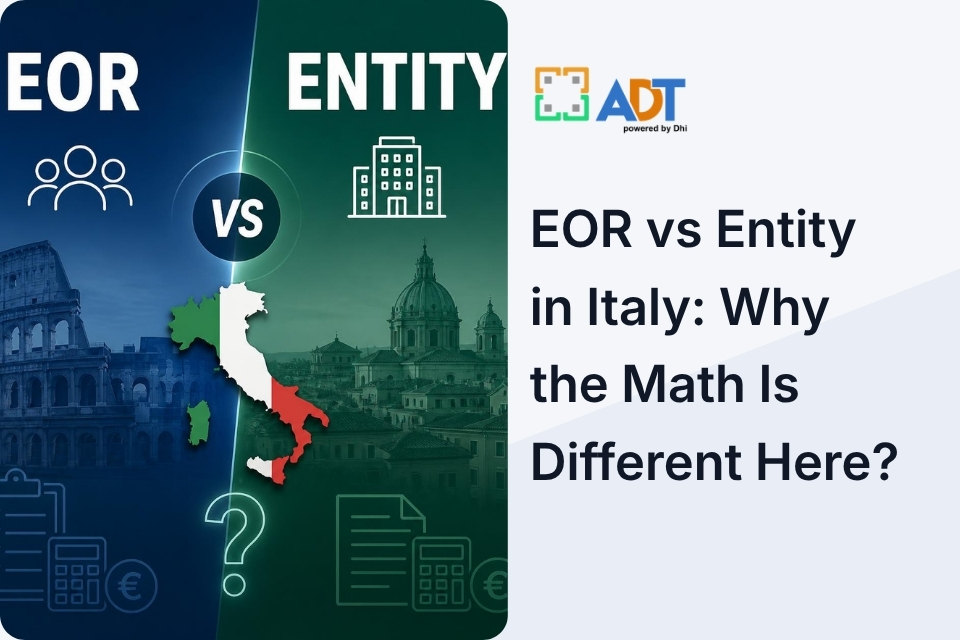

Most companies run the EOR vs entity decision as a spreadsheet exercise. Headcount, monthly fee, setup cost, breakeven point.
That spreadsheet works fine for the Netherlands. It gives you the wrong answer in Italy.
Italy has three structural features - a 900-agreement collective bargaining system, a mandatory severance fund that accrues from day one, and a legal entity setup process with more fixed overhead than most comparable EU markets - that shift the crossover point later than the "10 to 15 employees" heuristic that applies almost everywhere else in Western Europe. Getting this decision right requires understanding why, not just importing the number from your last expansion.
What is an Employer of Record ?
An Employer of Record is a company that legally employs your workforce in Italy on your behalf. The EOR signs the employment contract, runs payroll, withholds and remits taxes, manages INPS and INAIL registrations, calculates and administers TFR, and carries the compliance obligation for Italian employment law. Your company directs the work. The EOR carries the legal employment relationship.
For a market with Italy's level of regulatory density, this isn't just a convenience. It's a transfer of a genuinely complex compliance burden to a provider whose entire business is built around carrying it correctly.
What is a legal entity ?
A legal entity in Italy typically means an S.r.l. (società a responsabilità limitata) - the rough equivalent of a GmbH or a BV. Setting one up makes your business the direct legal employer. You register with INPS, INAIL, and the Agenzia delle Entrate. You determine the correct CCNL and employee grading yourself. You run payroll, file statutory accounts, and carry full responsibility for every employment law obligation, from the Comunicazione Obbligatoria pre-employment filing to termination procedure.
It gives you full operational control. It also gives you full exposure to every part of the Italian system that trips up companies who get there without local expertise already in place.
Why Italy's cost structure doesn't transfer from other markets?
The general EOR vs entity math - setup cost, timeline, ongoing overhead - holds directionally in Italy. The specifics don't.
Setup cost
Establishing an S.r.l. requires a minimum €10,000 in share capital, fully paid in at incorporation, plus notary fees and registration charges. Across most European markets, legal and setup costs for an entity run €15,000 to €40,000 before a single employee is hired. Italy sits within that range, but the ongoing requirement for a commercialista (accountant/tax advisor) and, separately, a consulente del lavoro (labour law and payroll consultant) means the fixed cost of staying compliant is higher than in markets where one advisor can reasonably cover both functions.
Timeline
Notary-based incorporation in Italy typically takes four to eight weeks. That's comparable to Germany, but it's still a three-to-six-month runway from decision to hire-ready once tax registration, INPS and INAIL enrolment, and payroll setup are accounted for. An EOR, by contrast, can have an employee on Italian payroll in one to three weeks.
Ongoing cost
This is where Italy diverges most. Two obligations sit on top of the standard payroll, accounting, and compliance overhead that every entity carries:
TFR (Trattamento di Fine Rapporto) accrues at a fixed 6.91% of total annual gross compensation, from the first day of employment, regardless of how the employment eventually ends. For a €55,000 salary, that's roughly €3,800 a year in additional liability money that isn't a line item you can defer or negotiate away, because the rate is fixed by law.
CCNL compliance isn't a setup task you complete once. Italy has over 900 active collective agreements, and the correct one for your business isn't always obvious for a foreign company without a clean Italian sector classification. Pay scales, notice periods, and leave entitlements under the applicable CCNL are periodically renegotiated, which means staying compliant is a standing legal-monitoring function, not a one-time determination.
A practical example
Take a company hiring its first employee in Italy at €55,000 gross.
Under an EOR: The provider's fee (typically €400 to €800 per employee per month across the European market, though Italy often sits toward the higher end given CCNL complexity) covers CCNL determination, payroll, TFR administration, INPS and INAIL filings, and ongoing compliance monitoring. Total cost is gross salary, plus statutory on-costs (INPS at roughly 27 to 30% of gross, plus TFR at 6.91%, plus INAIL), plus the EOR fee. The employee can start within one to three weeks.
Under your own entity: the same statutory on-costs apply TFR and INPS don't disappear because you're the direct employer. But you're also carrying entity setup cost (€15,000 to €40,000), a three-to-six-month runway before the first hire can start, and the ongoing cost of a commercialista and consulente del lavoro, typically €20,000 to €50,000 a year in fixed overhead before you factor in internal HR time.
For one employee, the EOR route is not close. The entity route only starts to make sense once enough headcount is absorbing that fixed overhead.
Why Italy's crossover point sits later than the general rule?
Across most of Europe, the point where a legal entity becomes more cost-effective than an EOR typically falls between 10 and 15 employees, once monthly EOR fees start to exceed the amortised cost of running the entity directly.
In Italy, that crossover point is generally higher often 12 to 18 employees for a structural reason: the fixed cost of Italian compliance infrastructure (commercialista, consulente del lavoro, and in some cases a statutory auditor) is higher relative to other major EU markets, and the risk being transferred to an EOR correct CCNL classification, TFR administration, the two-regime dismissal framework, disciplinary procedure requirements is more consequential to get wrong than in markets with simpler collective bargaining systems.
This doesn't make Italy a worse market. It means the "prove the market, then transition" approach that works almost everywhere in Europe holds for longer in Italy before the entity math flips in your favour.
When a legal entity makes more sense in Italy?
An EOR is the right starting point for most companies entering Italy. A legal entity becomes the better decision when:
Headcount grows past the 12-to-18 employee range, where amortised entity overhead starts to undercut cumulative EOR fees.
You need full control over incentive structures, equity plans, or HR policy design that goes beyond what a standard EOR arrangement supports.
Your Italian presence is permanent and strategic, and having a registered entity signals commitment to local clients, partners, or regulators in a way that matters commercially.
Bottom line
There's no universal answer to EOR vs entity in Italy. There's only the right answer for your headcount, your timeline, and how much of the CCNL and TFR compliance burden you want to carry directly versus transfer to a provider built around carrying it.
For most companies making their first one to five Italian hires, an EOR is the faster, lower-risk, and more cost-effective starting point. The decision to transition to an entity should be a deliberate one, modelled against your actual headcount trajectory not a default you reach for because it's what worked in your last market.
If you want to work through the specific numbers for your Italian expansion, we're happy to help. Reach out to the team at experts@adtsolution.com or visit adtsolution.com.






_1790144161.jpg)






 experts@adtsolution.com


 Queens towers, Delflandlaan 1, 1062 EA Amsterdam, The Netherlands



Comments (0)
No comments yet. Be the first to comment!