 AUG (Authorized User Group) Certified
 IND-recognised sponsor
 Nasscom Certified
 SNA Certified
Author : Shrinivas Sadalawar
Head of Product, ADT
Shrinivas leads product at ADT, focusing on building scalable systems for global workforce operations across payroll, EOR, and compliance. With a background in product strategy and platform development, he works on simplifying complex processes at scale.
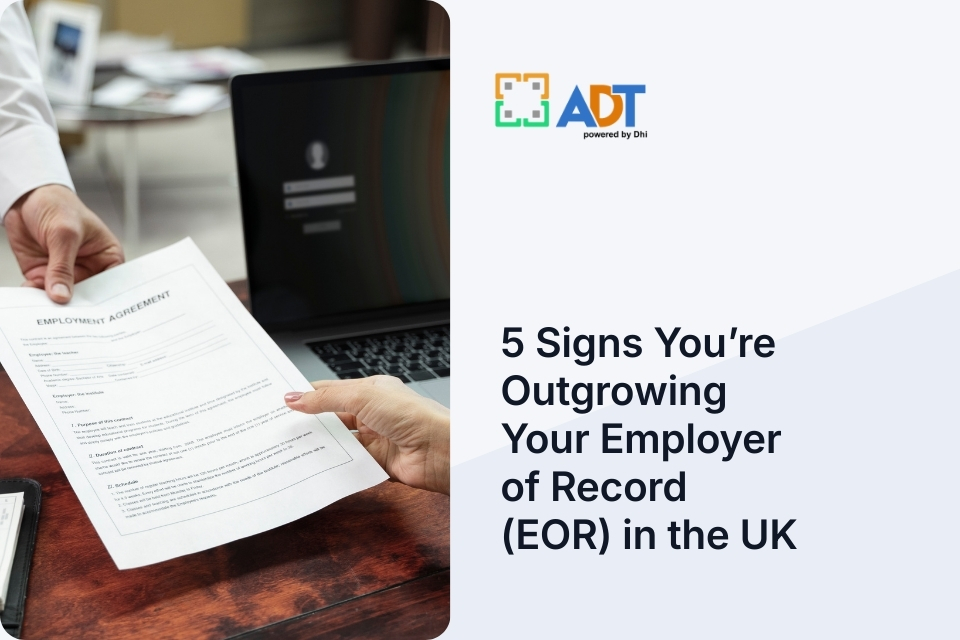
Expanding into the UK is often one of the first steps companies take when building a presence in Europe.
The market is mature, regulations are well defined, and talent is highly accessible. For many organizations, the easiest way to start hiring is through an Employer of Record (EOR) in the UK.
And for good reason.
An Employer of Record allows you to hire employees in the UK without setting up a local entity, manage payroll and compliance, and onboard talent quickly. For early-stage expansion, this model removes a significant amount of administrative and legal complexity.
But there is a point where the model begins to change.
Not because EOR stops working, but because your business has evolved.
Over time, companies often move from speed-driven expansion to structure-driven growth. At that stage, the question becomes less about convenience and more about operational efficiency.
In other words:
When does it make sense to move from EOR to your own UK entity?
After working with companies scaling across Europe for many years, we consistently see the same signals appear when organizations begin to review their EOR structure.
If your company is currently hiring in the UK, this is often a useful exercise to run internally.
Here are five of the most common signals.
1. Your UK Team Has Crossed 20 Employees
One of the clearest indicators is simple: headcount growth.
When companies first enter the UK market, the team size is usually small, often between 1 and 10 employees. At this stage, the administrative simplicity of an Employer of Record usually outweighs the cost difference between EOR services and operating a local entity.
However, as your team grows beyond 15–20 employees, the economics begin to shift.
Why?
Because many of the costs associated with setting up and maintaining a UK entity are fixed operational expenses:
• Accounting services
• Payroll infrastructure
• Corporate compliance filings
• Director and governance structures
When these costs are spread across a larger workforce, the per-employee cost declines significantly.
By contrast, EOR models typically operate on a per-employee service fee, which scales linearly with headcount.
At smaller team sizes, that tradeoff makes sense. But as your team grows, companies often begin comparing the long-term cost structure more closely.
Many leadership teams run a quick EOR vs entity cost comparison once they cross the 15–20 employee mark to understand where the break-even point might fall.
2. Hiring Velocity Has Become Predictable
Another strong signal is hiring stability.
When companies first expand internationally, hiring plans are rarely certain. Market testing, product validation, and customer traction can all influence how quickly the team grows.
That uncertainty is exactly where an EOR structure works best.
It allows companies to:
• Hire quickly
• Adjust headcount easily
• Avoid committing to long-term legal structures too early
However, once hiring becomes predictable, for example:
• A clear UK revenue pipeline
• A defined hiring roadmap
• Long-term local market commitment
The expansion strategy often evolves.
At that stage, the organization is no longer “testing the market.”
It is building a permanent operating footprint.
With that shift comes a different set of priorities:
• Margin optimization
• Internal governance
• Direct operational control
When leadership has visibility into the next 12–24 months of hiring, reviewing the workforce structure usually becomes part of the strategic planning conversation.
3. Your Finance Team Is Ready to Handle UK Compliance
Running payroll in the UK is not particularly difficult — but it does require discipline.
Employers must manage several ongoing obligations, including:
• PAYE payroll tax reporting
• National Insurance contributions
• Real Time Information (RTI) submissions to HMRC
• Pension auto-enrollment compliance
• Statutory benefits management
These processes are straightforward for experienced finance teams, but they require consistent oversight.
When companies first enter the UK market, internal finance teams may not yet have the capacity to manage country-specific payroll and compliance requirements.
That’s another reason EOR structures are valuable during early expansion.
The Employer of Record assumes the legal employer responsibilities, manages filings, and ensures payroll compliance with UK regulations.
But as companies scale internationally, finance teams often build stronger global payroll governance capabilities.
Once internal teams are comfortable managing:
• multi-country payroll
• statutory reporting
• compliance oversight
many organizations begin evaluating whether direct payroll management in the UK would provide greater operational visibility and control.
At this stage, some companies run a payroll structure review simply to understand what the transition would look like operationally.
4. You Need Greater Control Over Benefits and Pension Structures
One of the more subtle signals appears around employee benefits and pension design.
The UK has specific requirements around workplace pensions, and many companies eventually want to design benefits programs that reflect their internal compensation philosophy.
With an EOR structure, benefits and pension programs are typically standardized under the EOR’s framework.
This ensures compliance, but it can limit flexibility.
As organizations mature in a market, leadership teams often want more direct influence over areas such as:
• Pension contribution structures
• Equity and bonus programs
• Executive compensation design
• Custom benefits aligned with company policies
This is particularly common for companies building long-term leadership teams in the UK.
When that happens, the conversation often shifts from compliance convenience to employment structure design.
5. Your Focus Has Shifted From Speed to Margin Optimization
In the early stages of international expansion, speed is the dominant priority.
Companies want to hire quickly, validate the market, and begin generating revenue.
The EOR model supports that goal extremely well.
But as the organization grows, priorities naturally evolve.
Instead of asking:
“How quickly can we hire?”
Leadership teams start asking:
“How efficiently can we operate?”
At that point, operational questions become more relevant:
• Can we reduce long-term payroll costs?
• Can we simplify internal reporting structures?
• Can we align global HR processes across regions?
This is where companies begin comparing:
EOR costs vs operating their own UK entity.
For many companies, this is not an immediate transition decision.
It is simply the moment where leadership begins evaluating the long-term workforce structure.
Outgrowing EOR Is Not a Problem. It Is Progress
There is a common misconception that moving away from an Employer of Record means the model “stopped working.”
In reality, the opposite is usually true.
EOR often plays a critical role in helping companies:
• Enter the UK market quickly
• Build an initial team
• Establish early operations
When organizations eventually outgrow that structure, it is typically because the business has reached a new stage of scale and stability.
The real challenge is not deciding whether to move.
It is deciding when.
Transition too early, and you may introduce unnecessary operational overhead.
Wait too long, and you may absorb avoidable costs or structural inefficiencies.
The right decision depends on your company’s:
• hiring roadmap
• operational maturity
• financial structure
• long-term UK strategy
Not Sure Where Your UK Structure Stands?
If your team is currently hiring in the UK, it can be helpful to run a quick structural review before making long-term decisions.
We often work with companies evaluating:
• EOR vs entity cost structures
• UK payroll Services and compliance obligations
• headcount break-even points
• long-term operational implications
If you'd like clarity for your specific situation:
→ Request a 30-minute UK Workforce Structure Review (Contact details at end of the post)
or
→ Download EOR vs Entity Break-Even Worksheet
https://forms.gle/5EnZBgJUFXUjtZf46
In many cases the right decision is to stay on EOR longer.
In others, establishing a local UK entity begins to make more operational sense.
The most important thing is making the decision with clear visibility into the trade-offs.
Get in touch with us:
Netherlands (HQ) : +31 97010207974
UK (HQ) : +44 7401131349
Belgium : +32 460254634
Follow us on:
LinkedIn : https://www.linkedin.com/company/dhi-adt/


 Blue Card, Anmeldung & Netherlands Comparison_1788936018.jpg)








 experts@adtsolution.com


 Queens towers, Delflandlaan 1, 1062 EA Amsterdam, The Netherlands



Comments (0)
No comments yet. Be the first to comment!