 AUG (Authorized User Group) Certified
 IND-recognised sponsor
 Nasscom Certified
 SNA Certified
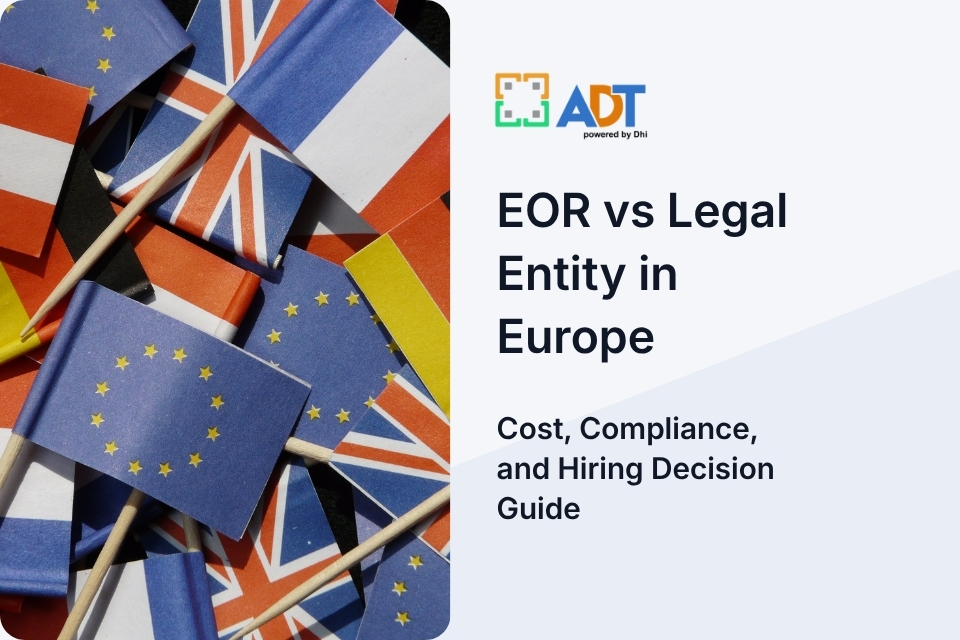

EOR vs Legal Entity in Europe: Full Cost Breakdown for Global Employers
When a company decides to hire in Europe for the first time, one question comes up before almost any other: do we set up a legal entity, or do we use an Employer of Record?
It sounds like a straightforward decision. In practice, most companies underestimate what each option actually involves, particularly the cost, the timeline, and the compliance obligations that come with both.
This article breaks down both paths clearly so you can make the right call for where your business is right now.
What is an Employer of Record?
An Employer of Record is a company that employs workers on your behalf in a country where you don't have your own legal presence. The EOR handles the employment contract, payroll, tax deductions, statutory contributions, and compliance with local employment law. Your company directs the work. The EOR handles everything else on the employment side.
For companies expanding into Europe without an existing entity, this is often the fastest and most practical route to getting someone on payroll legally.
What is a legal entity?
A legal entity, whether that's a subsidiary, a branch office, or a registered company, gives your business a direct legal presence in a country. You become the employer of record yourself. You run payroll, manage employment contracts, file statutory reports, and carry all compliance responsibility directly.
This gives you more control. It also comes with significantly more setup work, cost, and ongoing administrative overhead.
The real cost of setting up a legal entity in Europe
This is where most companies get surprised. The headline number for entity setup, the registration fee, is rarely the biggest cost. Here's what the full picture looks like.
Setup costs
Legal fees for company registration typically run between €3,000 and €10,000 depending on the country and the complexity of your structure. Add to that local notary fees, registration charges, and in some markets the requirement for paid-in share capital.
Across the major European markets, most companies spend between €15,000 and €40,000 getting a legal entity properly established before a single employee is hired.
Timeline
Entity registration in Europe is not a fast process. In Germany, the process typically takes eight to twelve weeks. In the Netherlands, you can move faster, but you still need to account for notary appointments, Chamber of Commerce registration, and tax registration. Belgium adds further complexity through its social secretariat requirements.
For most markets, you should budget three to six months from decision to hire-ready. If your hire is urgent, that timeline alone can kill the opportunity.
Ongoing costs
Once the entity exists, the costs don't stop. You now need:
Local payroll administration and processing. Local accounting and bookkeeping. Annual audit and compliance filings. Employment law support for contracts, changes, and terminations. Local HR management. Tax registration and ongoing tax filings across multiple authorities.
For a small team, these running costs can easily reach €20,000 to €50,000 per year before you factor in internal HR time.
The real cost of using an Employer of Record in Europe
EOR pricing is typically structured as a monthly fee per employee, either as a flat rate or a percentage of employment cost. Across the European market, fees generally sit between €400 and €800 per employee per month, depending on the country, the provider, and the services included.
What you get for that:
Locally compliant employment contracts. Full payroll processing including tax deductions and statutory contributions. Compliance management across employment law, social security, and benefits obligations. Employee onboarding and HR support. Ongoing regulatory monitoring so you don't have to track every change in employment law yourself.
For most companies hiring their first one to five people in a European country, the annual EOR cost is a fraction of what entity setup and maintenance would cost, while delivering faster access to the market and significantly less internal overhead.
Timeline
Most companies can onboard their first employee through an Employer of Record within one to three weeks. The documentation requirements vary by country, but there is no registration process, no waiting for government approvals, and no dependency on local notaries or chamber registrations.
If your hiring timeline is measured in weeks rather than months, EOR is almost always the right starting point.
Side by side: EOR vs legal entity
Setup cost: EOR — none. Legal entity — €15,000 to €40,000.
Time to first hire: EOR — one to three weeks. Legal entity — three to six months.
Ongoing compliance management: EOR — handled by provider. Legal entity — your responsibility.
Payroll administration: EOR — handled by provider. Legal entity — your responsibility.
Employment contracts: EOR — locally compliant, provided. Legal entity — you build and maintain.
Suitable for: EOR — early-stage, small teams, fast market entry. Legal entity — established presence, larger teams, long-term operations.
When does a legal entity make more sense?
An Employer of Record is the right starting point for most European expansions. But there are situations where building your own entity becomes the better long-term decision.
When your headcount in a single country grows significantly, typically beyond fifteen to twenty employees, the monthly EOR fees can start to exceed the amortised cost of running your own entity. The tipping point varies by country, provider, and the complexity of your workforce, but it is worth modelling at this stage.
When you need full operational control over employment terms, incentive structures, or HR policies that go beyond what a standard EOR arrangement supports, a legal entity gives you that flexibility.
When your presence in a country is permanent and strategic rather than exploratory, having your own entity signals commitment to local partners, clients, and regulators.
The practical approach most companies take is to start with an EOR, prove the market, build the team, and transition to a legal entity once the business case is established. EOR is not a temporary workaround. It is a legitimate, compliant employment model. But it works best when you treat it as part of a deliberate expansion strategy rather than a default.
Compliance: what each model actually requires
European employment law is not uniform. Each country has its own requirements around employment contracts, notice periods, probation, statutory benefits, payroll reporting, and termination. When you use an EOR, the responsibility for staying compliant with these requirements sits with the provider. When you run your own entity, it sits with you.
Common compliance risks for companies managing their own entities include payroll errors, worker classification mistakes, failure to meet local reporting deadlines, and gaps in employment contract compliance. In countries like Germany and Belgium, the consequences of getting these things wrong, from fines to employment disputes, can be significant.
Global payroll and workforce management across multiple European countries through a single EOR partner reduces this risk considerably. You have one point of accountability, one contract, and a provider whose entire business is built around staying current with local requirements.
The bottom line
There is no universally right answer between an EOR and a legal entity. There is only the right answer for where your business is right now.
If you are making your first few hires in Europe, working to a tight timeline, or testing a new market before committing to a permanent presence, an Employer of Record gives you compliant, fast access without the infrastructure overhead.
If you are building a long-term, large-scale operation in a specific country, a legal entity gives you the control and cost structure that makes sense at that scale.
Most companies do both — EOR first, entity later. The key is knowing where the crossover point is for your specific situation.
Get in touch with us:
Netherlands (HQ) : +31 97010207974
UK (HQ) : +44 7401131349
Belgium : +32 460254634
Follow us on:
LinkedIn : https://www.linkedin.com/company/dhi-adt/

 Blue Card, Anmeldung & Netherlands Comparison_1788936018.jpg)










 experts@adtsolution.com


 Queens towers, Delflandlaan 1, 1062 EA Amsterdam, The Netherlands



Comments (0)
No comments yet. Be the first to comment!